

Why Most Landscaping Companies Never Hit $1M (And How SEO Changes That)
Here’s an uncomfortable truth: most landscaping companies never break the million-dollar revenue mark. It’s not because they lack skill or work ethic. The problem is simpler. They’re invisible to customers actively searching for their services right now.
Think about your last big project. Where did that client come from? If you’re like most contractors, it was probably a referral or a repeat customer. That’s great for steady work, but it’s not a growth engine. Referrals are unpredictable. You can’t control when they happen, how many you get, or what services people need when they call.
Meanwhile, hundreds of homeowners in your area are Googling “landscaping company near me” every single week. Commercial property managers are searching for “commercial landscape maintenance.” New homeowners are looking for “landscape design services.” The question is: are they finding you, or are they finding your competitors?
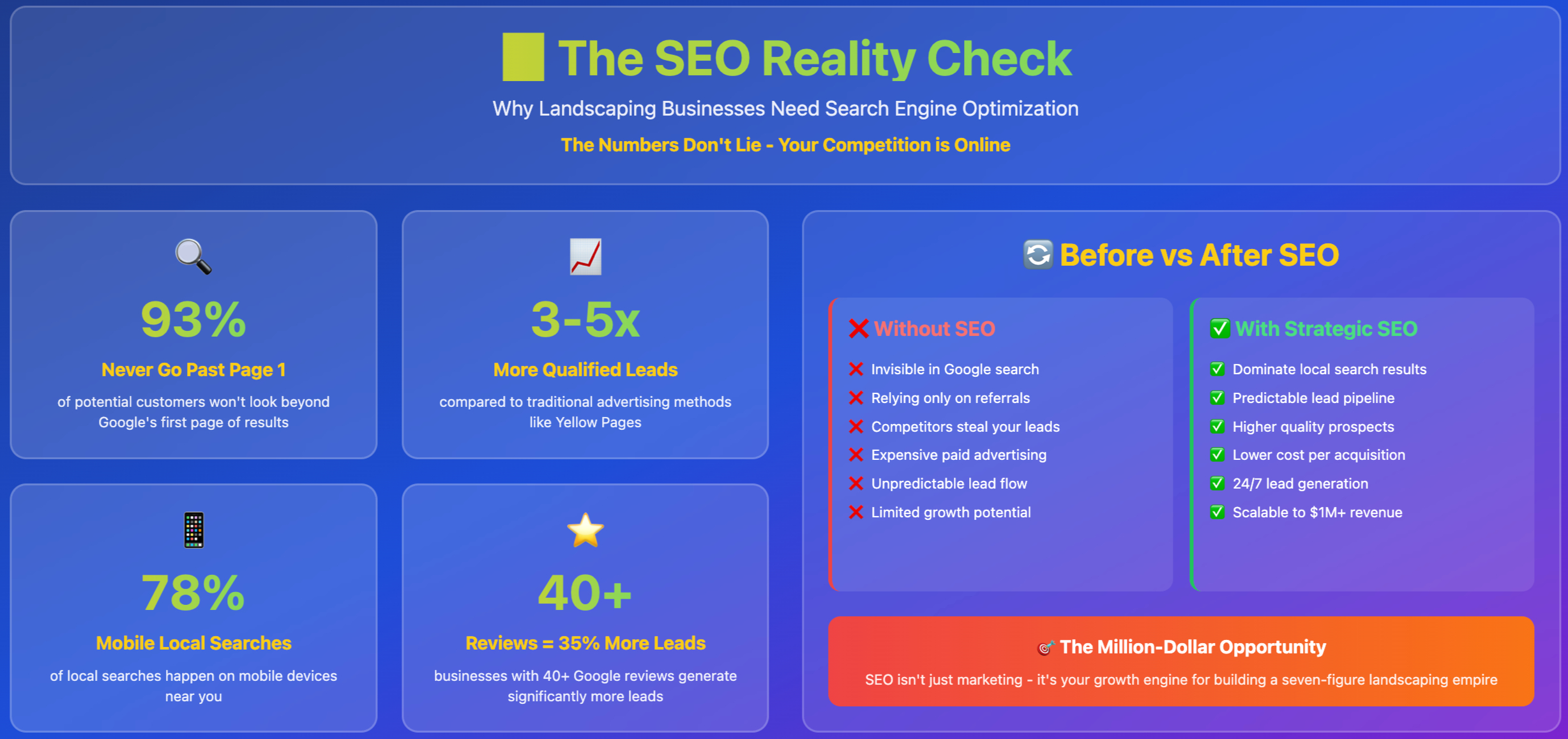
The numbers reveal where your next customers are looking. According to Backlinko’s comprehensive 2025 local SEO analysis, 46% of all Google searches now have local intent. Even more telling: 76% of consumers who search for something nearby visit a business within just one day. When someone searches for a landscaper on their phone, they’re not browsing casually. They’re ready to hire someone this week, possibly today.
This is where search engine optimization becomes your most powerful growth tool. Not paid advertising that stops working the moment you stop spending. Not door hangers that get tossed in the trash. Not even Yellow Pages listings that nobody opens anymore. Professional landscaping SEO puts your business in front of high-intent customers exactly when they’re ready to buy, and it keeps working around the clock.
The Math Behind $1M: What It Actually Takes
Let’s break down what a million dollars in annual revenue really means for your operation. Understanding these numbers helps you see why a consistent flow of more customers matters so much.
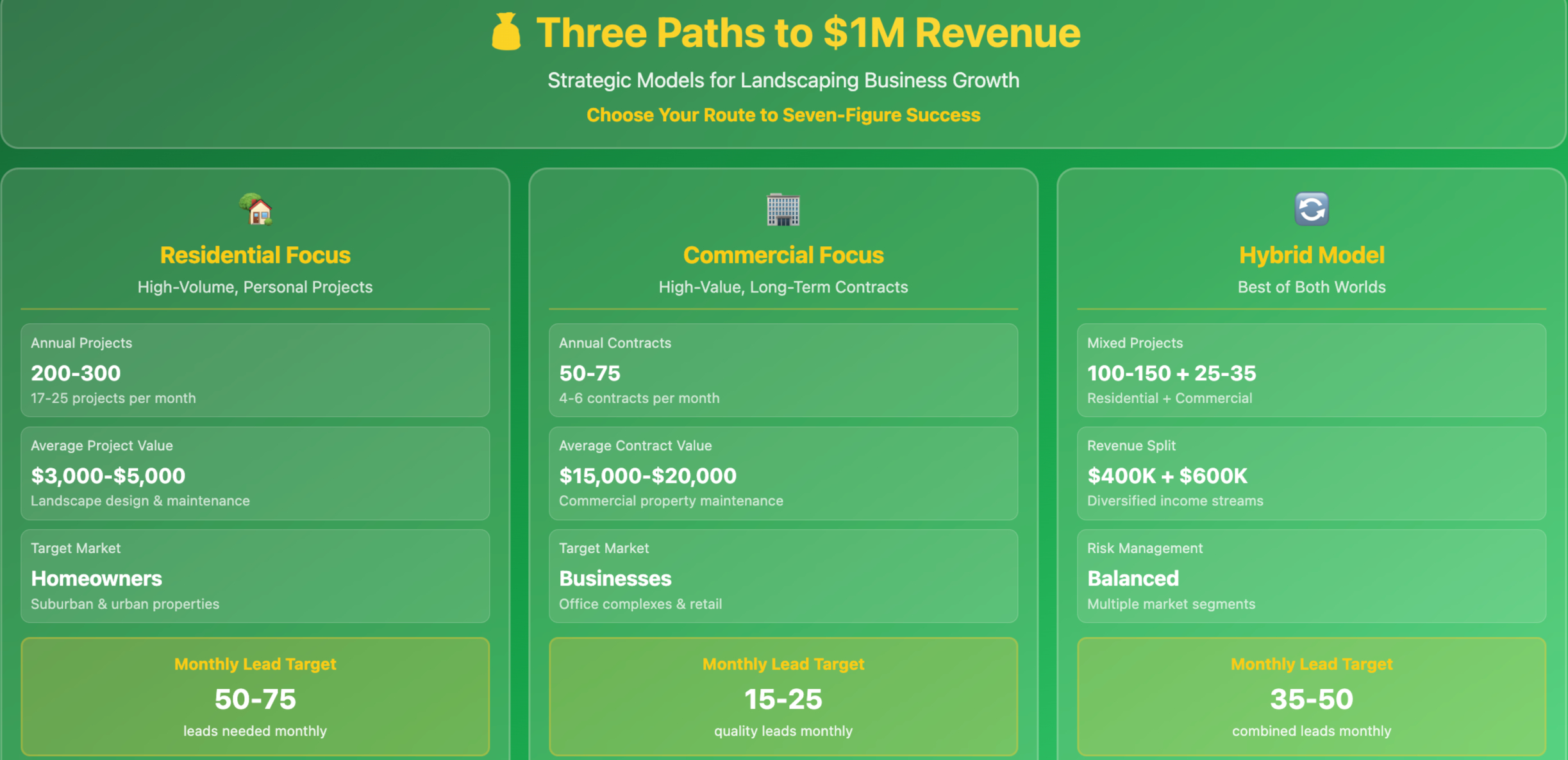
If you focus primarily on residential work, you’ll need roughly 200-300 projects annually, with an average ticket size of $3,500-$5,000. That breaks down to about 17-25 new projects every single month. Can referrals alone deliver that kind of volume consistently? Probably not, especially during slower seasons.
If you pursue commercial contracts, the numbers look different but the challenge remains the same. You’d need 50-75 contracts averaging $15,000-$20,000 each. These bigger deals take longer to close and require you to compete against established players with existing relationships. Being visible when facility managers and property owners research contractors becomes absolutely critical.
Most successful million-dollar operations run a hybrid model, combining 100-150 residential projects with 25-35 commercial contracts. This diversification reduces risk and smooths out seasonal fluctuations. During spring and summer, residential work keeps crews busy. In fall and winter, commercial maintenance contracts provide steady revenue. But here’s the key insight: whether you’re targeting homeowners or businesses, they all start their search the same way. They open a search engine and type what they need.
The landscaping businesses hitting these revenue targets aren’t just good at the work. They’re also good at being found. They show up when potential customers search. They appear credible and professional online. They make it easy for qualified prospects to contact them. In short, they’ve mastered the art of being visible at the exact moment buyers are ready to make decisions.
How Search Engines Connect Buyers With Your Services
When someone searches for “landscape design near me,” Google’s algorithm evaluates hundreds of factors in milliseconds to determine which businesses deserve those valuable top spots. Understanding how this process works helps you position your landscaping company for maximum visibility.
Search engines prioritize three core elements: relevance, proximity, and prominence. Relevance means how well your services match what the searcher wants. Proximity is simply how close you are to the person searching. Prominence reflects your overall authority based on reviews, website quality, and mentions across the web.
Think of it like this: Google wants to be the best answer machine in the world. Every time someone searches, Google’s reputation is on the line. If they show poor results, people stop using Google. So they’ve built incredibly sophisticated systems to identify which businesses can best serve each specific query.
Your goal is to send all the right signals. When your website clearly explains your offerings, when your Google Business Profile is complete and active, when you have dozens of positive reviews, when other sites link to yours, all of these factors tell Google: “This business is legitimate, professional, and worth showing to searchers.”
The beautiful part? Once you establish strong visibility, it compounds over time. Higher search rankings lead to more website visitors. More visitors lead to additional projects. More projects lead to more reviews. More reviews strengthen your position further. According to the same Backlinko research, 88% of people who conduct local searches on their smartphone visit or call a business within 24 hours. You create a virtuous cycle where visibility drives credibility, which drives more visibility.
But here’s what most contractors miss: search behavior changes throughout the buying journey. Early in the process, potential clients search for information like “how much does landscape design cost” or “best plants for shady yards.” Later, they search with higher intent, using phrases like “landscaping company in Denver” or “get landscape design quote.” Your landscaping SEO strategy needs to capture both types of searches to build a truly predictable pipeline.
What Makes SEO Different From Other Marketing Channels?
You’ve probably tried various marketing tactics over the years. Maybe you’ve bought leads from HomeAdvisor or Angie’s List. Perhaps you’ve run Facebook ads or tried direct mail campaigns. Some worked temporarily, others were complete duds. But here’s what makes an effective SEO strategy fundamentally different from everything else you’ve tried.
A successful SEO strategy targets active demand rather than creating it. When you run a Facebook ad, you’re interrupting someone’s day and hoping they happen to need your services. When you optimize for search, you’re positioning yourself in front of people who already decided they need a landscaper and are actively looking for one right now. The intent level couldn’t be more different.
Traditional advertising also requires constant spending. Run a radio ad for a month and it generates leads for that month. Stop paying and the leads stop immediately. Your landscaping website optimization, on the other hand, continues generating organic leads long after you’ve made the initial investment. Content you create today could bring in customers for the next five years.
The cost structure favors long-term thinking. Yes, getting your web pages properly optimized requires upfront investment. But compare the lifetime value. If you spend $5,000 on PPC ads, you might generate 50 leads that close into 10 landscaping projects worth $50,000 in revenue. Spend that same amount on professional landscaping SEO services and you might generate fewer leads initially, but those valuable leads keep coming month after month. By year two, you’re getting 200+ leads annually from that same initial investment.
How Do Local Searches Actually Work?
Understanding how Google decides which local businesses to show helps you make smarter optimization decisions. The process happens in three distinct stages, and your landscaping business needs to perform well at each stage.
First, Google discovers your business. Crawlers scan your website, read your profile, and catalog information about what landscaping services you offer and where you operate. If your website is poorly structured or your profile is incomplete, Google struggles to understand what you do. That’s like showing up to a networking event and refusing to tell anyone what kind of work you perform.
Second, Google evaluates your credibility. How many positive reviews do you have? Do other reputable websites link to yours? Is your contact information consistent everywhere it appears online? Google treats these signals like references on a resume. The more third-party validation you have, the more confident Google becomes in recommending you to local customers.
Third, Google matches you to relevant searches. When someone searches for “patio installation in Boulder,” Google looks for businesses that specifically mention patio installation, have a Boulder address, and demonstrate expertise in that service. The businesses that most clearly match all three criteria get the top spots in local search rankings.
This explains why some competitors with mediocre work rank higher than you. They’re not necessarily better landscapers. They’re just better at clearly communicating what they do and where they do it in ways that search engines can understand and verify.
What Revenue Model Works Best for Million-Dollar Growth?
Before diving into tactics, you need to understand which business model supports sustainable seven-figure revenue. The path you choose determines which SEO strategies matter most.
Pure residential lawn care companies can absolutely hit $1M, but it requires volume. At an average project value of $4,000, you need 250 projects annually. That’s roughly 20-25 new projects every month. Your SEO efforts needs to focus heavily on local pack visibility, review generation, and capturing high-volume search terms like “landscaping company near me.” Speed matters here because residential customers often call three companies and hire whoever responds fastest.
Commercial-focused operations hit $1M with fewer but larger projects. At $20,000 average contract value, you only need 50 deals annually. But these take 3-6 months to close and require you to beat established competitors. Your approach should emphasize expertise content, detailed case studies, and targeting facility managers who research extensively before ever making contact. You’re playing a longer game with higher stakes per deal.
The hybrid model offers the best risk-adjusted path. Combine 150 residential projects averaging $3,500 with 30 commercial contracts averaging $15,000. Residential work keeps cash flowing and crews busy during peak season. Commercial contracts provide predictable winter revenue and higher margins. Your approach needs to serve both audiences, which requires more sophisticated content but delivers more stable growth.
What Keywords Actually Generate Revenue?
Not all search traffic is created equal. Some keywords bring tire-kickers who want free advice. Others bring qualified buyers ready to spend money this week. Learning to distinguish between them determines whether your investment pays off.
Informational keywords build awareness but rarely convert immediately. Someone searching “how to design a backyard” is in research mode. They might hire a landscaper eventually, but probably not today. Should you create content for these searches? Yes, because you’re building authority. But don’t expect these visitors to become customers quickly.
Consideration keywords indicate active shopping. Searches like “best landscaping companies in Phoenix” or “landscape design cost” come from people who decided to hire someone and are now comparing options. These visitors are maybe 2-4 weeks from making a decision. Content targeting these terms should focus on differentiation and building trust.
Decision keywords signal immediate intent. When someone searches “landscaping company near me” or “get patio installation quote,” they’re ready to hire someone this week. These are your money keywords. Ranking well for decision-stage searches drives the most revenue per visitor.
Here’s the strategic insight most contractors miss. You need content for all three stages because customers move through them sequentially. The homeowner who reads your “backyard design ideas” article in February might search for your lawn care business in April. By showing up at every stage, you build familiarity and trust that converts into projects.
How Do You Find the Right Keywords to Target?
Keyword research sounds technical, but it’s really just structured thinking about how your customers search. Start by listing every service you offer, then imagine how someone would search for each one. Using a keyword research tool like Google Keyword Planner helps you understand search volume and competition levels for specific keywords.
Begin with your core services and locations. If you install patios in Austin, obvious choices include “patio installation Austin” and “Austin patio contractor.” But don’t stop there. Add neighborhood names, zip codes, and nearby suburbs. “Patio installation West Lake Hills” might have less traffic but much less competition.
Think about how customers describe problems, not just solutions. Someone might search “backyard flooding solution” rather than “drainage installation.” They search “brown patches in lawn” instead of “lawn disease treatment.” These problem-focused long tail keywords often convert better because they catch people earlier in their decision process.
Use Google’s own suggestions to expand your list. Type “landscaping” into Google and look at the autocomplete suggestions. Scroll to the bottom of search results for “related searches.” These show you exactly what real people in your service area are searching for right now. While Google Analytics helps you understand which relevant keywords already bring visitors to your site, initial research helps you identify new opportunities.
What Should Every Page on Your Website Include?
Each service page on your site serves as a standalone landing page for specific searches. Someone searching for irrigation installation shouldn’t land on your homepage and have to hunt for relevant information. They should land on a page entirely about irrigation.
Start with a clear headline using your title tag that includes the service and location. Something like “Professional Irrigation Installation in Boulder County” tells both visitors and Google exactly what this page covers. Avoid clever headlines that sacrifice clarity for creativity. When you optimize title tags properly, you’re setting yourself up for better visibility in search engine results pages.
Explain your process in plain language. Walk through what happens from initial consultation through project completion. Customers want to know what they’re getting into before they call. This builds trust and pre-qualifies leads so you spend less time on tire-kickers.
Include real project photos with captions. Not stock photos that could be from anywhere. Real work you’ve completed in your area. Captions should mention neighborhoods or landmarks when possible because this reinforces local relevance through on page SEO.
Add a clear call to action multiple times. Phone number, contact form, or “get a quote” button should appear near the top, middle, and bottom of the page. Make it ridiculously easy for interested visitors to take the next step and generate more qualified leads.
Answer common questions in paragraph form. What does this service typically cost? How long does installation take? What time of year works best? Address objections and concerns directly on the page rather than waiting for phone calls. Write compelling meta descriptions for each page that encourage clicks from search engine results.
The page should be comprehensive enough that someone could make an informed decision about calling you based solely on what they read. Aim for 800-1200 words of actual useful content, not fluff written to hit a word count. This detailed approach to creating web pages helps both visitors and search engines understand your expertise.
How Do You Optimize Your Google Business Profile?
Your Google Business Profile might be the single most important element of local SEO. When someone searches for services in your area, the local map pack appears above organic results. Getting into that three-pack drives massive traffic.
Claim and completely fill out your business listing. This sounds obvious but most contractors leave sections blank. Add every service category that applies. Write a detailed business description using natural language. Upload your logo and cover photo. Include business hours, service areas, and attributes like “veteran-owned” or “family-owned” if applicable.
Upload 100+ high-quality photos. This seems excessive but profiles with extensive photo galleries get significantly more engagement. Include completed projects from multiple angles, your team working, equipment, before and after shots, and seasonal updates. Add new photos every week to signal active management.
Post updates at least weekly. Google treats profiles like mini social media accounts. Post about completed projects, seasonal tips, special offers, or even weather-related advice. These posts appear in search results and keep your profile looking fresh and active.
Collect and respond to every review. Set up automated review requests that go out after project completion. Make it easy by including direct links. Respond to all reviews within 24-48 hours, even the positive ones. A simple “Thanks for trusting us with your landscape, Maria” shows you’re engaged. Strong reviews help boost rankings across all search platforms.
Keep information absolutely consistent across all business listings. Your business name, address, and phone number must match exactly across your website, profile, and every entry in local directories. Even small differences can confuse search engines and hurt your local rankings.
What Type of Content Should You Create?
Content marketing intimidates many lawn care companies, but it’s simpler than you think. You’re not trying to become a publishing company. You’re documenting your expertise in ways that help potential customers while improving search visibility.
Write about projects you’ve recently completed. Turn each major project into a case study. Explain the customer’s challenge, your solution, and the results. Include plenty of photos and mention specific neighborhoods or property types. These posts naturally include keywords and local references while showcasing your work. A well-crafted blog post can rank in search results for years.
Answer questions customers actually ask. Every estimate call includes questions about costs, timelines, materials, or maintenance. Turn each frequent question into an article. “How Much Does Paver Patio Installation Cost in Denver?” or “Best Time of Year for Landscape Design Projects.” You’re already answering these questions verbally. Writing them down extends that value to anyone searching online.
Create seasonal content ahead of time. In January, write about spring preparation. In July, write about fall cleanup. Publish seasonal content 6-8 weeks before the season starts because that’s when people begin searching and planning. This timing captures customers early in their decision process.
Focus on local relevance whenever possible. Instead of generic “lawn care tips,” write “Lawn Care for Colorado’s Clay Soil and High Altitude.” Instead of “common landscape mistakes,” write “Landscape Challenges Unique to Phoenix Desert Climate.” Local specificity helps with rankings and resonates better with your actual customers. Remember that SEO refers to optimizing for both search engines and human readers.
You don’t need to publish daily or even weekly. Two high-quality, detailed articles per month will outperform ten rushed, thin posts. Consistency matters more than frequency, and quality content naturally attracts more traffic to your site over time.
What Technical Issues Hurt Your Rankings?
Technical SEO sounds complicated but most issues are straightforward to fix once identified. These problems often prevent otherwise good websites from ranking well.
Site speed matters more than most contractors realize. If your site takes more than 3 seconds to load on a mobile device, you’re losing both visitors and rankings. Large uncompressed images are usually the culprit. Use tools like TinyPNG to compress photos before uploading. A fast site isn’t just better for search engine optimization; it converts more visitors into leads.
Mobile optimization is non-negotiable. More than 70% of local searches happen on phones. If your site doesn’t work perfectly on mobile devices, you’re essentially closing your business to the majority of customers. Text should be readable without zooming. Buttons should be easy to tap. Forms should be simple to complete on a small screen.
Create a logical site structure with clear navigation. Your main services should be accessible from the homepage in one click. Related services should link to each other through internal linking. Someone reading about patio installation should see easy links to outdoor lighting or pergolas. This helps both visitors and search engines understand how your services relate.
Fix broken links and missing pages. Use free tools like Screaming Frog or Google Search Console to identify broken links. Every 404 error frustrates visitors and signals poor site maintenance to search engines. Schedule quarterly audits to catch and fix issues.
Most technical problems don’t require a developer to fix. Content management systems like WordPress make these adjustments accessible to non-technical users. If something seems truly complex, hire a developer for a few hours rather than letting technical debt accumulate. Understanding what technical SEO involves helps you prioritize improvements that matter most.
How Do You Build Authority Through Links?
Link building has a sketchy reputation because some agencies use manipulative tactics. But legitimate off page SEO simply means getting other reputable websites to reference yours, which signals credibility to search engines. Building quality backlinks remains one of the most important ranking factors.
Start with easy local links. Join your local chamber of commerce and get listed in their directory. Connect with suppliers who might link to customer sites. Reach out to local real estate agents who could reference landscapers they recommend. These aren’t high-authority links, but they’re legitimate and locally relevant.
Create content others want to reference. Comprehensive local guides naturally attract links. “Complete Guide to Drought-Resistant Landscaping in Southern California” might get linked to by water conservation sites, local news, or gardening blogs. You’re not asking for links. You’re creating something genuinely linkworthy that demonstrates your landscapers SEO expertise.
Partner with complementary businesses. Build relationships with pool builders, outdoor kitchen installers, or deck contractors. You serve the same customers but aren’t competitors. Feature each other in project case studies or maintain referral partner pages on your websites.
Get featured in local media when opportunities arise. Completed an interesting project? Pitch it to local news or home and garden sections. Expert commentary on seasonal topics, like preparing landscapes for weather extremes, positions you as an authority. Each media mention usually includes a link to your site. These quality backlinks from reputable sources carry more weight than dozens of low-quality directory links.
Avoid buying links, using link farms, or participating in reciprocal link schemes. These tactics might work briefly but risk penalties that tank your rankings. Build links slowly and naturally by being genuinely useful to your community and industry.
What Mistakes Do Most Contractors Make?
Learning from others’ failures saves time and money. These mistakes appear repeatedly across the industry and can derail even well-intentioned SEO efforts.
Expecting overnight results. SEO is a 6-12 month game, not a 6-week sprint. Companies that abandon their strategy after two months never see results. The contractors who dominate search results stuck with optimization for years, not months. Set realistic expectations or you’ll quit before gaining traction.
Neglecting your profile. Some contractors spend thousands on website optimization while ignoring their Google listing. That’s backwards. Your profile appears above website results in Google Maps and influences whether customers even click through to your site. Optimize your profile first, then your website.
Creating duplicate content across location pages. Many contractors copy-paste the same service description across every city they serve, changing only the city name. Search engines recognize this and may penalize the site. Each location page needs unique content with genuine local references and insights.
Ignoring mobile users. If you test your site only on a desktop computer, you have no idea what mobile users experience. Test every page on an actual phone. Click every button. Fill out your contact form. If anything feels clunky or difficult, fix it immediately.
Chasing every new tactic while ignoring fundamentals. The SEO industry promotes new trends constantly. Voice search optimization! AI content! Video content! These can help, but they’re useless if you haven’t mastered basics like complete service pages, regular content, and review generation. Perfect the fundamentals before chasing advanced tactics. Following proven SEO tips consistently beats jumping on every new trend.
How Does SEO for landscapers Work With Other Marketing?
SEO shouldn’t exist in isolation. The most successful landscaping marketing strategies integrate search optimization with other channels for maximum impact.
Use paid ads to test keywords before optimizing. Running Google Ads for specific services shows which keywords actually convert into paying customers. Once you identify winners, invest in organic optimization for those terms. This approach reduces wasted effort on keywords that don’t generate revenue. Google Search data from paid campaigns provides valuable insights for your organic strategy.
Social media drives brand awareness that improves search performance. When more people search for your business by name, Google interprets that as a signal of brand strength. Content shared on social media platforms doesn’t directly improve rankings, but it builds the audience that searches for you specifically. Cross-posting between social media and your website creates multiple touchpoints with potential customers.
Email marketing to past customers encourages reviews. Stay in touch with completed projects. Send seasonal reminders, helpful tips, and review requests. These reviews strengthen your local SEO while email marketing maintains relationships that generate repeat business and referrals.
Traditional marketing can boost search volume. Yard signs, vehicle wraps, and sponsorships increase brand awareness. More people become aware of your business name, some search for it later, and that branded search activity signals strength to Google.
The channels reinforce each other. Strong search presence makes paid ads more effective because people recognize your brand. Social media content provides material you can repurpose as website content. Everything connects when you think strategically about the customer journey and how different channels work together.
What Changes Should You Prepare For?
Search evolves constantly, but certain trends are clear enough to prepare for now. Understanding these shifts helps you adapt your lawn care SEO approach proactively.
AI-generated search results will affect click-through rates. Google’s AI Overviews now appear for many queries, potentially reducing clicks to websites. The solution is creating content so detailed and helpful that even after reading an AI summary, people want to visit your site for complete information. Beyond Google, other search engines are also implementing similar AI features.
Voice search continues growing but doesn’t require special optimization. Optimize for natural conversational questions and you’re ready for voice. Someone speaking to their phone asks “what’s the best landscaping company near me” rather than typing “landscaping company near me,” but the intent is identical.
Google will increasingly prioritize proven expertise. Generic content written by anyone about anything will rank poorly. Content demonstrating genuine experience, like detailed case studies with photos and specific results, will rank better. This favors actual contractors over content marketing agencies.
Mobile-first indexing means your mobile site IS your site. Google now uses the mobile version of your site for ranking decisions. If something only exists on desktop, Google might not see it at all. Test and optimize mobile first, then ensure desktop works well too.
Local pack visibility will become even more competitive. As more businesses optimize their profiles, standing out requires going beyond basics. Extensive photos, frequent posts, strong review volume, and quick response times become minimum requirements rather than advantages.
The contractors who survive these changes are those who focus on genuinely serving customers well and documenting that service online. Algorithm updates target manipulative tactics. Authentic expertise and helpfulness remain safe bets regardless of technical changes.
How Do You Measure Success?
Tracking the right metrics helps you double down on what works and abandon what doesn’t. Understanding your return on investment from landscaping SEO services ensures you’re spending wisely.
Monitor leads from organic search specifically. Use call tracking numbers on your website, ask how people found you, and check analytics to see which pages generate contact form submissions. You need to know how many leads come from search versus other channels.
Track keyword rankings for your money terms. Check monthly where you rank for searches like “lawn care company [your city]” or “patio installation [your area].” Improving from position 12 to position 4 directly correlates with more visibility and leads.
Measure conversion rate, not just traffic. Getting more website visitors means nothing if they don’t contact you. If organic traffic increases but leads don’t, you’re ranking for wrong keywords or your site doesn’t convert visitors effectively. Fix the conversion problem before chasing more traffic.
Calculate customer acquisition cost from organic leads. If you spend $3,000 monthly working with an SEO agency and generate 20 leads that close into 4 projects worth $20,000 total, your acquisition cost is $750 per project on $80,000 in revenue. Compare that to acquisition costs from paid ads or lead generation services.
Review Search Console data quarterly. This free tool shows which searches trigger your site to appear in results, your click-through rate, and technical issues Google discovers. It’s your direct line to understanding how Google sees your site and what improvements matter most.
Success in SEO isn’t about vanity metrics like domain authority or page views. It’s about generating profitable revenue at a sustainable cost. Keep your metrics focused on business outcomes, not industry jargon.
Your Path Forward: What Should You Do This Week?
SEO can feel overwhelming when viewed as one giant project. Break it into manageable steps and progress becomes inevitable.
This week, focus on your Google Business Profile. Log in, complete every section, upload 20 quality photos, and post your first update. Write a compelling business description in natural language. This single task improves visibility more than any other action you could take.
Next week, audit your website for mobile usability. Visit every important page on your phone. Is text readable? Do buttons work? Can you fill out the contact form easily? Fix obvious problems immediately. If the site needs a complete rebuild, that becomes your next major project.
Within the first month, establish your content calendar. Commit to publishing two detailed articles monthly. Create a list of 24 topics based on questions customers ask and services you want to promote. Schedule time to write or hire someone to help. Consistency matters more than perfection.
By month three, implement systematic review collection. Set up automated emails requesting reviews from satisfied customers. Create a process your team follows after every completed project. This single habit, maintained consistently, transforms your visibility over time.
The Reality About Million-Dollar Growth
Building a million-dollar operation through search engine optimization isn’t complicated, but it isn’t quick either. It requires sustained effort over 12-24 months before you see truly transformative results.
You’ll invest thousands in optimization and content. You’ll spend hours learning about algorithms and customer behavior. Some months will feel like nothing is happening. Then suddenly, you’ll notice more quote requests coming through the website. Phone calls will mention “I found you on Google.” Project volume will steadily increase.
The companies that break through to seven figures share one characteristic above all others: they simply don’t quit. They optimize their profile, publish content, collect reviews, fix technical issues, and keep doing these things month after month regardless of whether immediate results appear.
Think about your market position today versus one year ago. If you’ve been optimizing consistently, you’re almost certainly more visible than you were. Now project that improvement forward another year. Then another. Compound growth in search visibility creates compound growth in revenue.
Your competitors are either ignoring SEO entirely or approaching it inconsistently. They’ll start strong, lose interest, try again six months later, then abandon it again. That inconsistency is your advantage. Show up consistently and you win by default.
The path to a million dollars in annual revenue isn’t mysterious. Generate predictable high-intent leads through search visibility. Convert those leads into projects through professionalism and clear communication. Deliver excellent work that generates positive reviews. Those reviews strengthen your search presence, generating more leads. Repeat this cycle for 24 months and you’ll be running a fundamentally different business than you are today.
Ready to start? Open your Google Business Profile right now. Upload five photos. Write one post. That’s how million-dollar growth begins, with simple actions repeated consistently over time.