


TL;DR: The U.S. home remodeling market hit $509 billion in 2025 for owner-occupied homes alone (total market exceeds $600 billion). But here’s the real story: the market didn’t just grow – it got re-benchmarked $30 billion higher after data revealed the pandemic boom was 26.6% larger than anyone estimated. High interest rates created a “stay-in-place” economy where 90% of homeowners hire professionals for major projects. Kitchen and bath remains a $235 billion powerhouse, while exterior projects deliver ROI of 200%+. The labor shortage costs $10.8 billion annually, but it’s also eliminated low-cost competition. This report breaks down spending tiers, project ROI vs. “joy scores,” brand rankings, and the remodeling marketing strategies that actually work in 2025.
Home Remodeling Market Size and Valuation
What is the total size of the remodeling market in 2025?
The home remodeling market size depends on what you’re measuring, and understanding this distinction is critical for strategic planning.
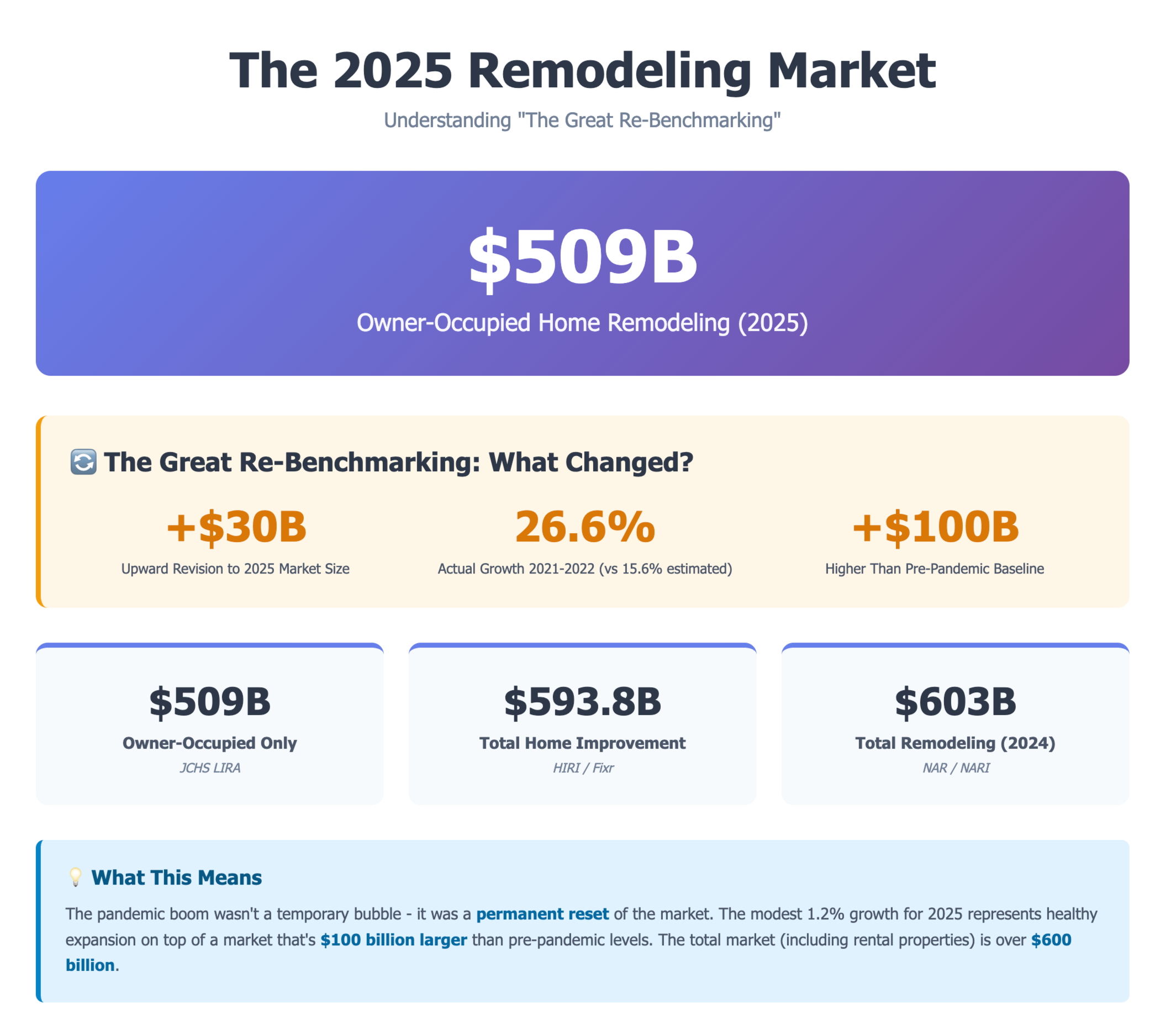
The Joint Center for Housing Studies of Harvard University (JCHS) projects that national spending on remodeling and repairs for owner-occupied homes will reach $509 billion in 2025, representing a modest 1.2% increase from 2024.
But this single number is misleading without context.
What is “The Great Re-Benchmarking”?
This projection comes after what the industry calls “The Great Re-Benchmarking” – a massive upward revision where JCHS increased its 2025 market size projection by $30 billion, or 6.4%.
New data from the 2023 American Housing Survey revealed that the post-pandemic remodeling boom was far larger than any model estimated:
- The homeowner remodeling market expanded by 26.6% between 2021 and 2022 (from $407 billion to $515 billion)
- This actual growth was substantially higher than the 15.6% growth originally estimated
- The market contracted only modestly in 2023, by 1.0% to $510 billion, proving pandemic gains weren’t a temporary bubble
Translation: The modest 1.2% growth for 2025 is actually healthy, sustainable expansion on top of a market baseline that’s approximately $100 billion higher than pre-pandemic levels.
How do different market size reports compare?
Multiple sources report the market at $593-603 billion. Here’s how to reconcile the numbers:
Home Improvement Research Institute (HIRI) / Fixr: Projects the total home improvement market at $593.8 billion in 2025 (3.4% growth), exceeding $614.6 billion in 2026.
National Association of Realtors (NAR) / NARI: Estimated Americans spent $603 billion in 2024 on home remodeling.
Global Market Insights: Projects a 4.2% CAGR for the U.S. remodeling market (2025-2034).
The difference: The JCHS LIRA ($509B) tracks only owner-occupied homes. The larger figures include spending by both homeowners and rental property owners. JCHS itself noted that total market spending (owner + rental) “soared above $600 billion in 2022”.
Market Size Comparison Table:
| Data Source | 2025 Projected Spend | Y-o-Y Growth | Scope |
|---|---|---|---|
| JCHS LIRA | $509 Billion | 1.2% | Owner-Occupied Only |
| HIRI / Fixr | $593.8 Billion | 3.4% | Total Home Improvement |
| NAR / NARI | (2024: $603B) | N/A | Total Remodeling |
Remodeling Market Trends and Drivers
What is contractor confidence like in 2025?
Professional remodeler sentiment remains firmly positive. The NAHB/Westlake Royal Remodeling Market Index (RMI) posted a reading of 60 in Q3 2025. Any score above 50 indicates more remodelers view conditions as “good” than “poor”.
The National Association of Home Builders projects a 5% gain in residential remodeling activity in 2025.
What is the “stay-in-place” economy?
The 2025 remodeling market has successfully decoupled from the new-build and real estate sales markets. The primary driver is a “stay-in-place” economy, where homeowners are choosing to “remodel-in-place” rather than move.
The “Golden Cage” of Interest Rates:
High interest rates have created “limited options to move”. Homeowners with low-rate mortgages are “locked-in,” and as a result, they are “choosing to stay in place and reinvest in their properties”. The NKBA explicitly identifies “remodeling-in-place” as a “critical substitute for relocation”.
This transformed remodeling from a discretionary purchase into a functional necessity for households whose needs have changed but who can’t afford to buy a new home at current rates.
What are the key market drivers for 2025?
Aging Housing Stock:
The nation’s aging housing stock is a “key factor for growth”. Older homes require constant investment in critical systems – roofing, windows, HVAC, plumbing – plus modernization to meet contemporary standards.
Aging-in-Place (AIP) Boom:
73% of industry leaders report that requests for aging-in-place features have increased in the last five years. As a result, 56% of remodelers are now actively involved in AIP home modification work – installing barrier-free bathrooms, walk-in showers, and wider doorways.
Remote Work Persistence:
Hybrid and remote work schedules continue driving renovations. Homeowners are adapting spaces for dedicated home offices and multifunctional rooms.
Are homeowners hiring professionals or going DIY?
The data shows a clear bifurcation: “DIY maintenance” versus “pro-led transformation.”
Professional hiring dominates:
According to the 2025 Houzz & Home Study, 90% of renovating homeowners (9 in 10) hired professional help for their projects in 2024.
Pro hiring is growing: The share of homeowners hiring specialty service providers increased from 46% in 2022 to 49% in 2024.
Project scale is increasing: 57% of NARI members reported an increase in the scale of projects, with clients remodeling more than one room at a time or requesting larger, more complex projects.
What is the growth rate for pro-led vs. DIY projects?
In the kitchen and bath sector, spending on professional-led remodels is projected to rise by 2.9% in 2025. This growth far outpaces the 0.6% increase forecasted for DIY kitchen and bath activity.
For contractors: Homeowners may DIY small cosmetic projects to save money, but they’re overwhelmingly turning to professionals for the large-scale, multi-room transformations required to make their “stay-in-place” homes functional for the long term.
Kitchen and Bath Market Statistics
How big is the kitchen and bath market in 2025?
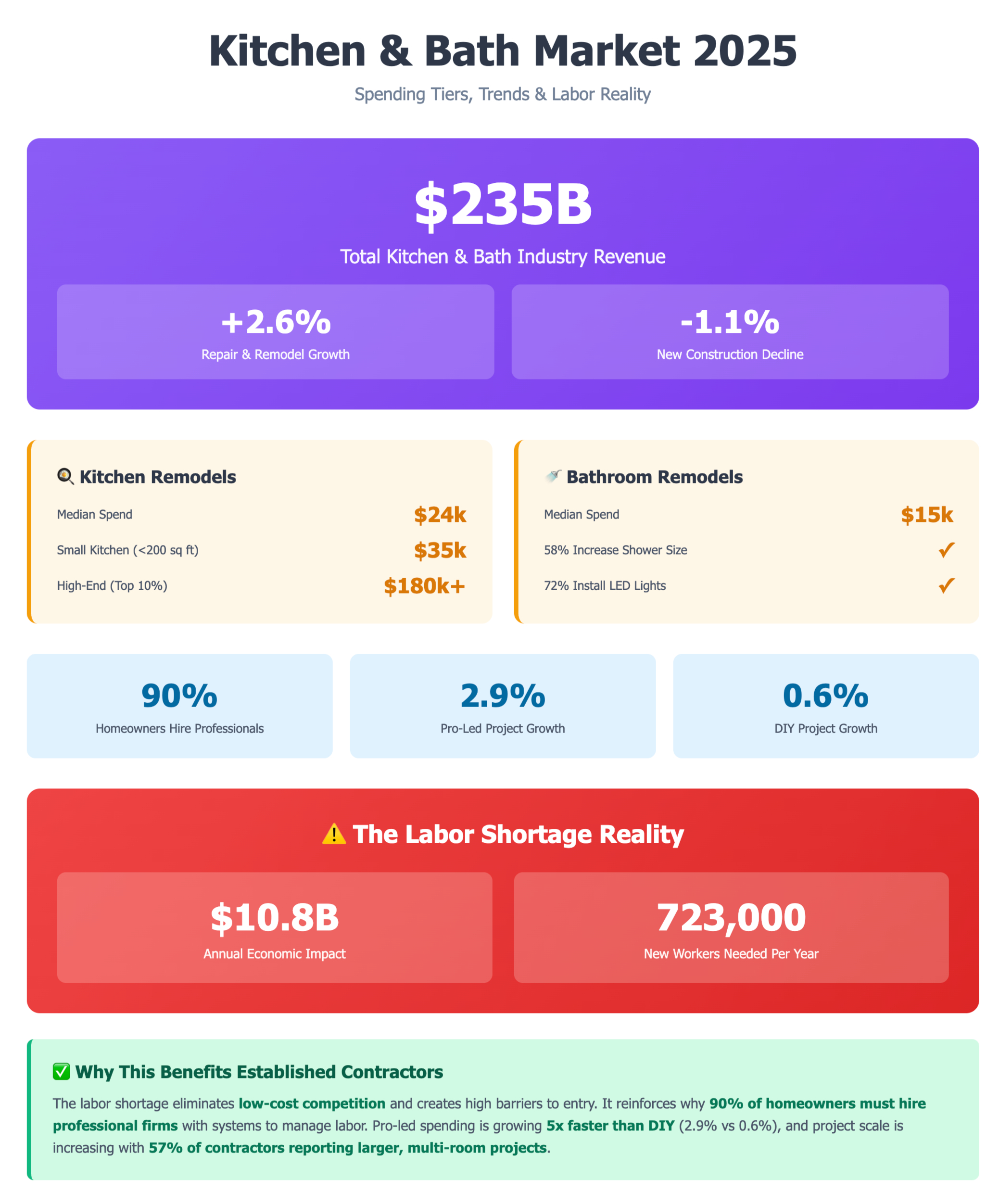
The kitchen and bath (K&B) industry is massive. The National Kitchen & Bath Association projects the total K&B industry will generate $235 billion in revenue in 2025.
While overall growth is modest (0.8%), the breakdown reveals the real story:
This split proves that the repair and remodel sector is the 2025 growth engine, driven by existing homeowners reinvesting in their properties rather than new home sales.
What is the average cost of a kitchen remodel in 2025?
Kitchen spending is highly stratified by budget tier:
Median spend: The median spend on a kitchen renovation rose 20% to $24,000.
High-end projects: For the top 10% of spenders, the investment is $180,000 or more for a major remodel.
Small kitchens: For kitchens under 200 square feet, median spend increased 9% to $35,000.
What percentage of homeowners want smart kitchens?
A remarkable 75% of homeowners want smart kitchens with eco-friendly features in 2025.
What are the top kitchen design trends for 2025?
The “Organic” Kitchen:
The all-white kitchen trend is over. The market is shifting to medium to dark wood cabinets, with walnut and mahogany tones leading in popularity. Natural materials and earth tones dominate.
Natural stone countertops:
Granite, quartz, and marble remain top choices. Trends include “waterfall edges” where stone flows down the side of an island, and rich veining patterns that create visual impact.
The “Concealed Kitchen”:
A dominant trend is hiding technology and small appliances. This includes:
- “Appliance garages” to hide toasters and coffee makers
- Panel-ready refrigerators and dishwashers that blend seamlessly with cabinetry
Smart integration:
What percentage of homeowners remodel within the original kitchen footprint?
64% of homeowners renovate their kitchen within its original footprint.
What is the average cost of a bathroom remodel in 2025?
The median spend on a primary bathroom renovation rose 11% to $15,000.
What are the top bathroom trends for 2025?
The “Super Shower” trend:
Homeowners are removing bathtubs to create larger, more luxurious showers. 58% of renovators are increasing the size of their primary bathroom shower.
Walk-in showers and accessibility:
This “super shower” trend aligns directly with aging-in-place. Walk-in showers with low thresholds are installed by 29% of renovators, while 14% install barrier-free (no threshold) walk-in showers. This design blends spa-like aesthetics with long-term accessibility.
LED lighting adoption:
72% of bathroom renovators are installing LED lights. Smart mirrors with built-in lighting are also trending.
Floating vanities:
Wall-mounted “floating” vanities are the top choice for renovators. They create an illusion of more space (ideal for smaller bathrooms) and provide a sleek, modern aesthetic.
What percentage of bathroom renovators install water-efficient features?
42% of bathroom renovators are installing water-efficient features.
Remodeling Project ROI and Joy Scores
Which remodeling projects have the highest ROI?
The 2025 Cost vs. Value Report reveals that exterior replacement projects offer the highest financial return at resale. These are typically lower-cost, high-impact “curb appeal” upgrades.
Top ROI projects (2025):
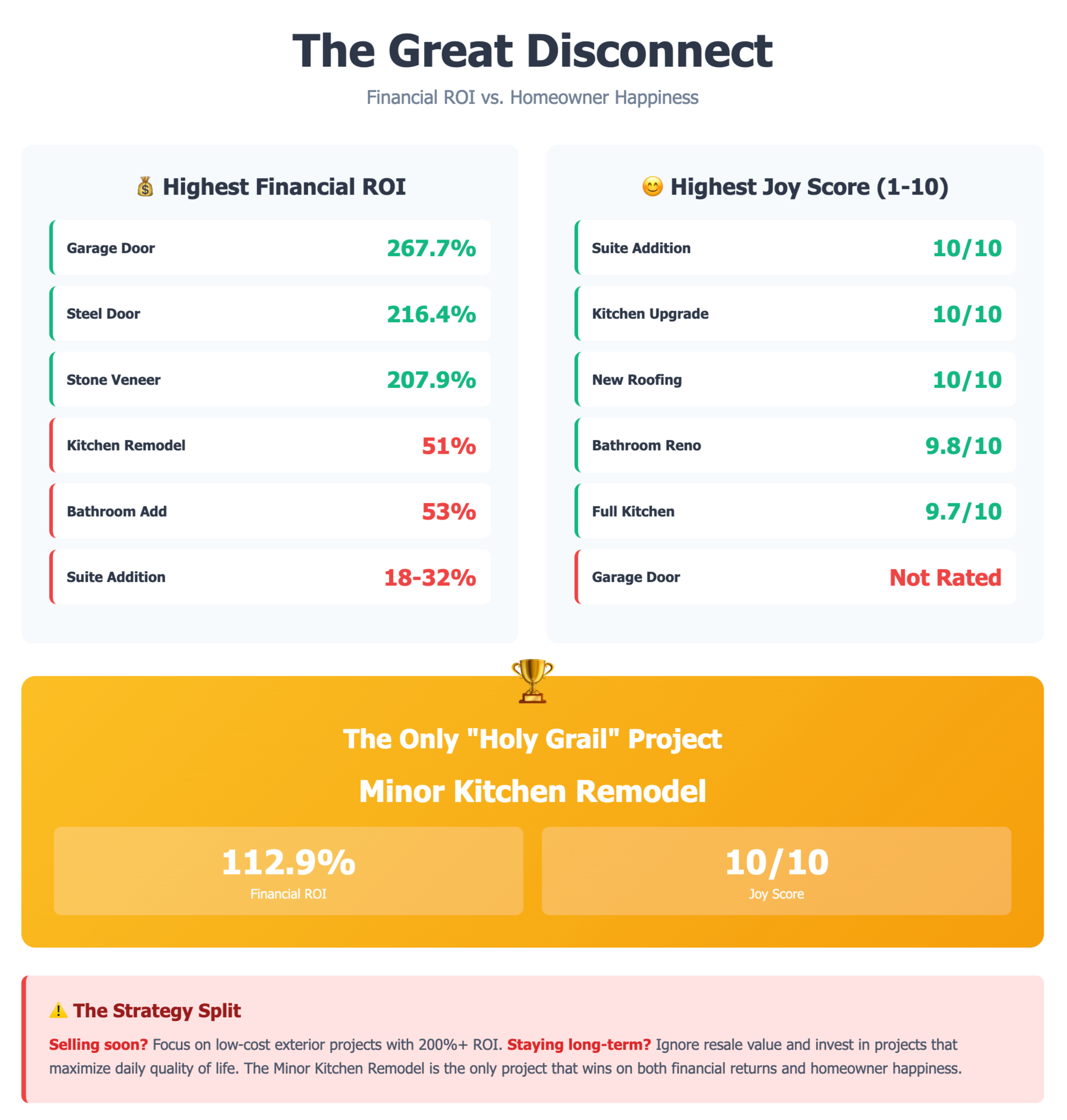
- Garage Door Replacement: 267.7% cost recouped
- Steel Door Replacement: 216.4% cost recouped
- Manufactured Stone Veneer: 207.9% cost recouped
- Fiber-Cement Siding Replacement: 113.7%
- Minor Kitchen Remodel: 112.9%
Exterior dominance: Overall, 8 of the top 10 projects for cost recouped are exterior replacements, including siding and deck additions.
What is the ROI for major interior renovations?
Large, personalized interior projects have much lower financial ROI:
- Major Kitchen Remodel (Midrange): 51% ROI
- Bathroom Addition (Midrange): 53% ROI
- Roofing Replacement (Metal): 50% ROI
What is the “Holy Grail” remodeling project?
The Minor Kitchen Remodel is the only interior project to rank in the top five ROI projects, yielding a powerful 112.9% ROI. This project involves surface-level upgrades like cabinet refacing, new countertops, and new hardware – not a full layout change.
What is a “Joy Score” in remodeling?
The NAR/NARI 2025 Remodeling Impact Report measures homeowner happiness with a “Joy Score” on a scale of 1-10. This data reveals that the projects homeowners love the most are often the ones with the worst financial ROI.
Projects with a perfect 10/10 Joy Score:
Other high-joy projects:
What is “The Great Disconnect” in remodeling ROI?
A “Primary Suite Addition” rates a perfect 10/10 for “Joy” but has one of the worst financial returns with an ROI of only 18-32%.
Conversely, a “Garage Door Replacement” with its 267.7% ROI doesn’t register on the “Joy Score” list at all.
For contractors: The only project that succeeds on both scales is the Minor Kitchen Remodel: 112.9% financial ROI and 10/10 Joy Score.
What percentage of homeowners feel happy after completing a remodel?
43% of homeowners feel “happy” when they see their completed project.
What is the ROI for a basement conversion?
A basement conversion to a living area returns 71% of its cost at resale.
Outdoor Living and Exterior Remodeling Trends
How big is the outdoor living market?
The backyard has been transformed from a simple yard into a “second living room” and fully functional extension of the home.
Market size: The global outdoor deck and patio market was valued at $15.7 billion in 2024, projected to grow at 4.9% CAGR (2025-2032). The U.S. market for outdoor living structures is growing even faster at 5.3% CAGR (2025-2030).
How much has demand for outdoor spaces increased?
The demand for outdoor spaces has increased by 50% since 2020 – a durable, post-pandemic behavioral shift.
Are patios more popular than decks?
Yes. In 2023, 63.7% of new single-family homes included patios (a record high). In contrast, only 17.5% included decks (a post-2004 low).
What are the top outdoor living trends?
Spending is focused on function, not just aesthetics:
- “Outdoor kitchens” and “pizza ovens” are top trending features
- “Covered patios” are the most popular type, favored by 44% of experts because they offer all-weather usability
- Pergolas and patios together account for 63.6% of all outdoor structure revenue
How big is the siding market?
The global siding market is valued at $125.8 billion in 2024, projected to grow at 5.1% CAGR through 2034.
What percentage of home improvement spending affects energy use?
More than a third of owner improvement expenditures are for projects that affect energy use, specifically including exterior components like siding, windows, and roofing.
What are the top siding color trends for 2025?
The market is shifting to bold, dark colors like dark blues and grays.
What is the growth rate for insulated vinyl siding?
What percentage of home improvements are basement or attic conversions?
Smart Home and Sustainability Statistics
What percentage of homes have smart devices in 2025?
In 2025, 63% of U.S. households have at least one smart home device. There are 72 million smart speakers in use.
Why are homeowners adopting smart home technology?
Energy Savings (56%): This is the #1 reason cited for adopting smart home technology. Smart thermostats alone can reduce heating and cooling energy use by an average of 18% per household.
Security (38%): Smart security systems have seen 38% growth in installations compared to 2023.
Convenience: 68% of all smart home interactions in 2025 are initiated via voice assistants.
How much can smart devices increase home value?
Installing smart devices in a home can increase its resale value by 5%.
What is the reliability problem with smart appliances?
While demand is high, the data reveals a critical “Smart Appliance Paradox”: the technology is significantly less reliable than non-connected counterparts.
A 2025 J.D. Power U.S. Appliance Reliability & Service Study reveals a major performance gap:
- Non-connected appliances: 63 problems per 100 appliances (PP100)
- Smart appliances with Wi-Fi/Bluetooth: 87 PP100 (38% higher problem rate)
- Smart appliances (active users): 92 PP100 (even worse for owners who use the features)
For contractors: This reliability gap creates callbacks and service issues. There’s an opportunity for contractors who can educate clients about this tradeoff.
What is the financial ROI of green building?
“Sustainability” has transitioned from an ethical consideration to a core financial strategy in 2025:
Increased asset value: Owners report that green buildings and renovations have an increased asset value of over 9%.
Lower operating costs: Green buildings see:
Brand Rankings and Contractor Perception
Which power tool brands do contractors prefer?
Professionals show strong “ecosystem” loyalty, primarily to DeWalt, Milwaukee, and Makita. Hilti is recognized in trades as a premium brand known for durability and fleet service programs.
Which dishwasher brands have the best reliability?
Based on J.D. Power reliability rankings:
Which wall oven brands have the highest customer satisfaction?
Bosch ranks highest in customer satisfaction (749 score).
Which microwave brands have the highest customer satisfaction?
Frigidaire ranks highest (736 score).
Which faucet brand do contractors trust most?
A Farnsworth Group study found that Moen is perceived by contractors as having “best performance and best customer service”. This perception of superior service is a powerful purchasing driver for trade professionals.
What is the bathroom fixture market share breakdown?
Labor Shortage and Workforce Statistics
How much does the labor shortage cost the industry?
The skilled labor shortage has a quantifiable annual economic impact of $10.8 billion on the home building sector alone ($8.1B in lost production + $2.7B in higher costs).
How many new workers does the construction industry need?
The construction industry needs to attract approximately 723,000 new workers per year to meet demand and replace outgoing workers.
What percentage of construction workers are women?
Women now make up 11.2% of construction employment (a 20-year high).
What percentage of construction workers are immigrants?
Immigrant workers account for 25.5% of the workforce (historic high), and one in three construction craftsmen.
For contractors: While the labor shortage is a challenge, it solidifies the business model of professional remodelers. It creates a high barrier to entry, eliminates low-cost competition, and reinforces why 90% of homeowners must hire professional firms with systems to manage labor.
Remodeling Contractor Marketing Statistics
How much more effective is content marketing for contractors?
Contractors who invest in content marketing (educational blogs, project case studies) see 54% more leads than those using traditional methods only.
How effective are interactive visualizers for lead generation?
How much do 3D product demonstrations increase conversions?
Companies that use AI-generated 3D content and virtual product demonstrations see a 94% increase in conversion rates. This technology (VR/AR/Digital Twins) is being adopted by high-end remodelers to provide immersive project walkthroughs before construction begins.
Conclusion: What the Data Tells Remodeling Contractors About 2025
The 2025 home remodeling market isn’t just stable – it’s fundamentally stronger than anyone realized. The Great Re-Benchmarking proved the pandemic boom wasn’t a bubble. It was a permanent reset that added $100 billion to the market’s baseline.
Three structural forces define 2025:
1. The “Stay-in-Place” Economy Is Real
High interest rates locked homeowners into their current properties. They can’t afford to move, so they’re forced to adapt their homes to their lives. This transformed remodeling from discretionary spending into functional necessity. The result: 90% hire professionals, project scale is increasing 57% year-over-year, and pro-led spending growth (2.9%) crushes DIY (0.6%).
2. The ROI Disconnect Creates Sales Opportunities
The data reveals two distinct homeowner types:
- Sellers should focus on exterior curb appeal – garage doors return 267.7%, stone veneer returns 207.9%
- Long-term stayers should ignore resale value and maximize “Joy Scores” with kitchen upgrades (10/10), bathroom renovations (9.8/10), and primary suite additions (10/10)
- The only “Holy Grail” project that delivers both high ROI (112.9%) and high joy (10/10) is the minor kitchen remodel
3. The Labor Shortage Is Your Competitive Advantage
The $10.8 billion annual impact sounds like a problem. But for established contractors with systems, training, and retention strategies, it’s protection. The shortage eliminated low-cost competition, raised barriers to entry, and forced 90% of homeowners to hire professionals who can manage complex projects.
The marketing playbook that works:
- Content marketing generates 54% more leads
- Interactive visualizers make homeowners 2.5x more likely to convert
- AI-generated 3D walkthroughs increase conversion rates by 94%
The contractors winning in 2025 aren’t chasing cheap clicks – they’re building sophisticated digital sales funnels that pre-qualify, educate, and convert before the first phone call.
The opportunity:
Kitchen and bath is $235 billion. Outdoor living is up 50% since 2020. Smart home adoption hit 63%. The market baseline is $100 billion higher than pre-pandemic. Homeowners are locked in. Projects are getting bigger. The competition has a labor problem they can’t solve.
The contractors who understand this landscape – who can navigate AIP modifications, explain smart appliance tradeoffs, position minor kitchen remodels as the “Holy Grail,” and build remodeling digital marketing systems that generate qualified leads – those are the contractors who will capture disproportionate market share in 2025 and beyond.
The market is $509 billion. The opportunity is massive. The question is whether you’re positioned to take it.
Read also: Landscaping industry statistics 2025, Hvac market statistics 2025