


TL;DR: Plumbing companies can run ChatGPT Ads today through OpenAI’s self-serve Ads Manager, with ZIP-code targeting, a $25 daily minimum and a suggested starting bid of $3 to $5 per click. But a lot of plumbing work is the wrong fit. A homeowner with a burst pipe wants to call someone in the next two minutes, and Google’s Local Services Ads are built for that: the lead is a phone call or message, and ads can follow your business hours. A ChatGPT ad has no call button and no hour-of-day schedule. Where it does fit is the work people research before they hire: water heater replacements, tankless conversions, sewer lines, repipes. Test it on those jobs and judge it against the number you already know, your cost per booked job from Local Services Ads.
This is the plumbing version of our ChatGPT Ads guide for home services, which covers the basics and a general setup checklist. Here we stick to what is different for plumbers. Every OpenAI setting below was re-checked in OpenAI’s Ads Manager help center on October 24, 2026. ChatGPT Ads is still labeled beta, so expect changes.
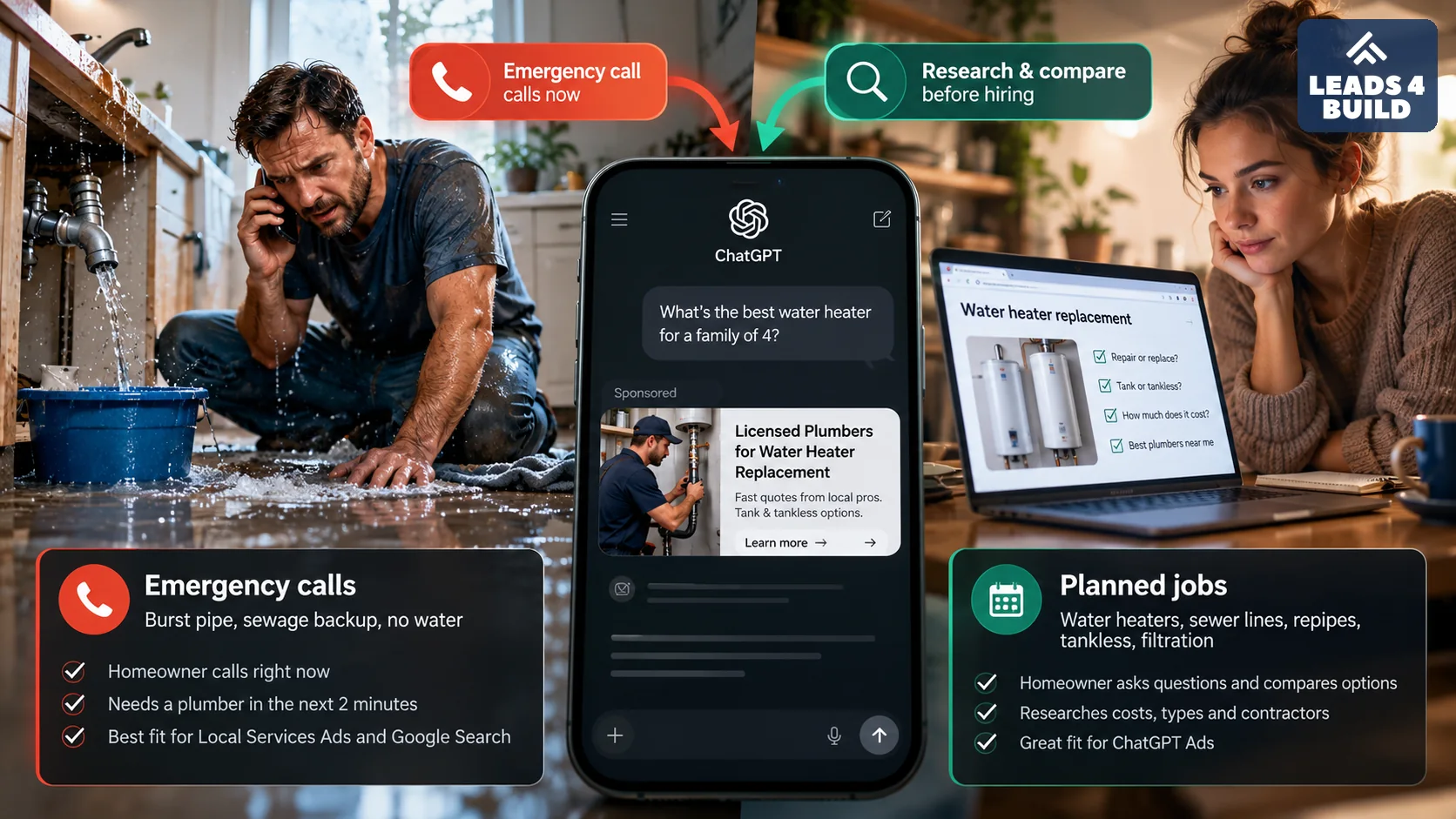
Emergency calls vs planned jobs: where ChatGPT fits
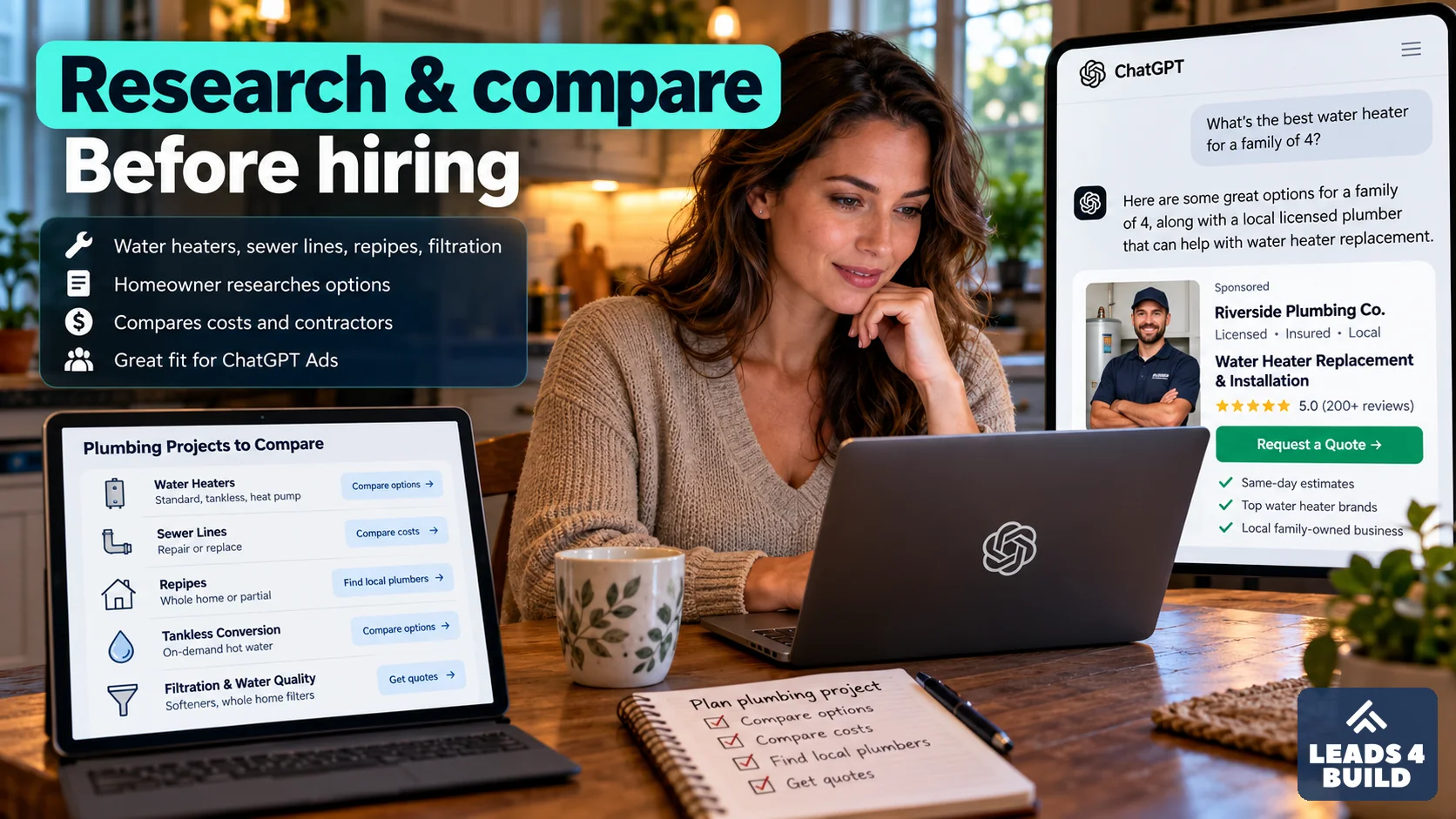
Some plumbing work can’t wait an hour: water on the floor, sewage in the tub. Some waits weeks while the homeowner reads about options and prices. ChatGPT Ads suit the second kind, for three reasons built into the product:
- No call button. OpenAI’s ads basics page lists what an ad contains: advertiser name, logo, title, description, landing page and image. There is no call element. Every lead has to click through to your page first.
- No hour-of-day schedule. A campaign has start and end dates, locations and platforms (campaign guide), but no setting for hours or days, and OpenAI says context hints “cannot enforce geographic limits, schedules, or exclusions.” Local Services Ads, by contrast, offer “All day,” “Only during my business hours” and “Custom hours” (Google ad scheduling help).
- Uneven daily spend. The daily budget is an average over a week. OpenAI says “Delivery need not be even within a day or across the week” and a campaign that uses its weekly allowance early “may stop delivering until the next budget week.” You can’t count on it being live at 2 a.m. on a Saturday.
So sort your services by how the homeowner behaves before they call:
| Job | What the homeowner does first | Fit for ChatGPT Ads |
|---|---|---|
| Burst pipe, sewage backup, no water | Searches “emergency plumber near me” and calls the first answer that picks up | Weak. Keep this on Local Services Ads and Google Search |
| Clogged drain, running toilet, small leak | Often asks how to fix it themselves first | Weak. Low ticket, lots of do-it-yourself research |
| Water heater failed or failing | Asks whether to repair or replace, tank or tankless, and what it costs | Good. Urgent, but the homeowner is still deciding |
| Sewer line or slab leak repair | Asks about methods (trenchless vs digging), cost and whether insurance covers it | Good. Big bill, lots of questions |
| Repipe, tankless conversion, water softener or filtration, gas line for a pool heater or outdoor kitchen | Compares options and contractors over days or weeks | Best. Planned, high-ticket, researched |
This sorting is our reading of how homeowners act, not survey data. Put your ChatGPT money on jobs where people ask questions before picking a plumber, because that is when the ad appears.
What a plumbing ad looks like in ChatGPT
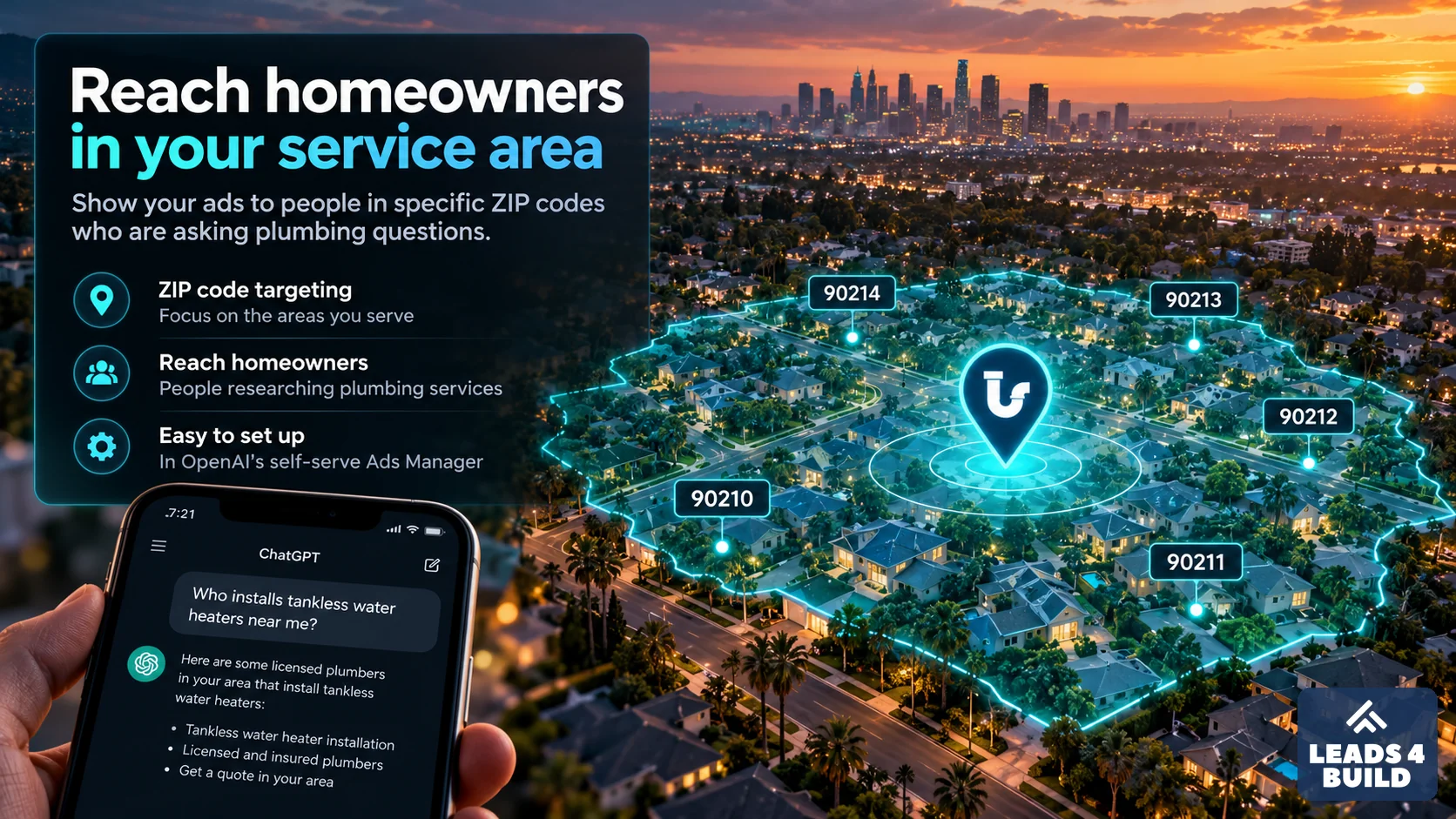
The ad is a card shown below ChatGPT’s answer, matched to the conversation without keywords. Plus, Pro and Business users and accounts identified as under 18 don’t see ads.
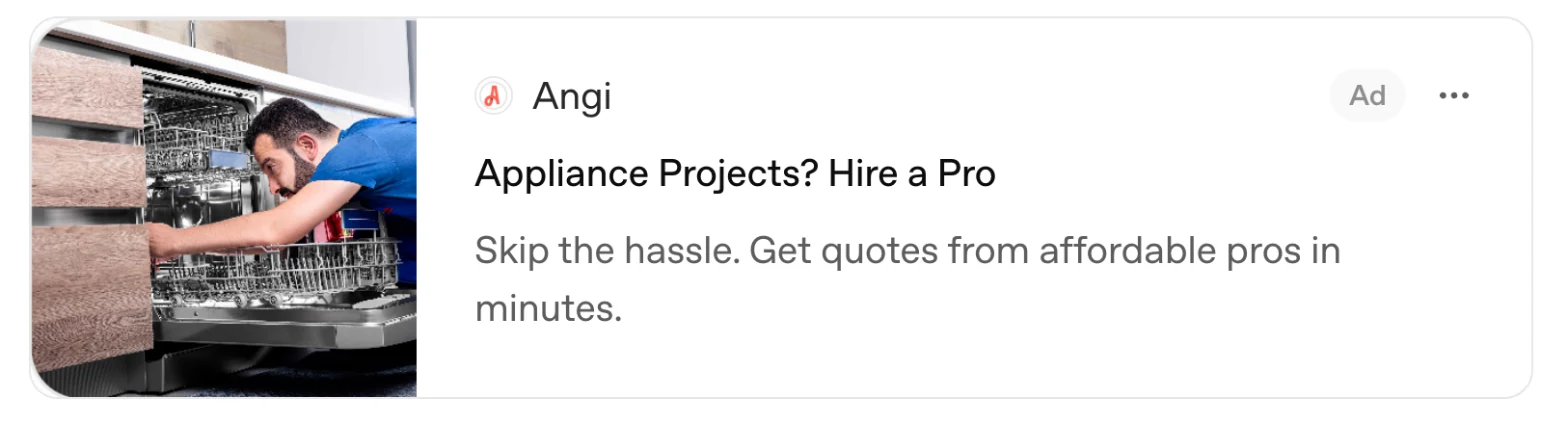
Home service leads are already in this auction. OpenAI’s Angi customer story (September 22, 2026) says Angi started in “roughly 20 home service categories,” expanded into “nearly 30 additional” ones, and saw cost per lead fall 34% after moving to conversion-optimized campaigns. Its search lead describes the audience as people “ready to hire or exploring a DIY route.” For a plumber, the DIY group matters: plenty of people asking about a running toilet will fix it themselves, so point your ads at jobs a homeowner can’t do alone.
The number to beat: your Local Services Ads cost per lead
Most plumbers who would test ChatGPT Ads already pay for Google leads, so that is the benchmark. The most detailed recent plumbing numbers we found come from SearchLight Digital, a reporting company that publishes its clients’ data. In February 2026, plumbing Local Services Ads averaged $57 per lead across 230 accounts and $2.03 million in spend, with a 44.5% book rate (leads that became a booked appointment) and a $1,714 average ticket (SearchLight LSA benchmarks). For non-branded Google Search, the same company reports a $183 average cost per lead in the first quarter of 2026 ($168 median) and a median of $333 per paying customer (SearchLight plumbing Google Ads data).
Chart: average cost per lead for US plumbing companies by Google channel, from SearchLight Digital’s client data. Local Services Ads: February 2026, 230 plumbing accounts. Search and Performance Max: January to March 2026, 524 plumbing contractors; the Performance Max figure mixes branded and non-branded campaigns. No comparable ChatGPT Ads figure has been published.
Two caveats. This is one vendor’s client base, not an industry census. And Google is moving Local Services Ads into the main Google Ads platform as Performance Max campaigns with pay-per-lead goals, starting in August 2026 with “select home and storefront service advertisers in the U.S.” including plumbing (Google help). You “still only pay for valid leads (such as phone calls and messages),” but compare your own numbers rather than older benchmarks.
What a ChatGPT click has to do to compete
Local Services Ads charge per lead; ChatGPT Ads charge per click (or per 1,000 views), so your lead price depends on how many clicks call or fill a form. Our arithmetic at OpenAI’s suggested $3 to $5 bid:
| To match… | At $3 per click | At $5 per click |
|---|---|---|
| $57 per lead (plumbing LSA average) | 1 lead every 19 clicks (about 5%) | 1 lead every 11 clicks (about 9%) |
| $183 per lead (non-branded Search average) | 1 lead every 61 clicks (about 1.6%) | 1 lead every 37 clicks (about 2.7%) |
Beating non-branded Search looks reachable for a good landing page. Beating Local Services Ads on cost per lead is harder. The fairer comparison is cost per booked job, because a lead that books a repipe is worth far more than one that books a drain cleaning. With SearchLight’s two LSA averages, $57 per lead at a 44.5% book rate works out to roughly $128 of spend per booked appointment. Pull the same two numbers from your own LSA account before you start.
Plumbing ad groups built around researched jobs
OpenAI’s ad group guide uses a plumber as its example: “a plumbing business might use separate ad groups for emergency repairs and preventive maintenance.” We would go further: one ad group per job people research, each with its own landing page:
| What the homeowner is asking ChatGPT | Ad group | Landing page | Priority |
|---|---|---|---|
| “My water heater is 12 years old and leaking. Repair or replace?” | Water heater replacement | Water heater page with tank and tankless options, installed price ranges and how fast you can install | High: urgent and researched |
| “Is a tankless water heater worth it for a family of four?” | Tankless conversion | Tankless page with sizing, gas or electric requirements and real installed costs | High if you install them |
| “Sewer line repair: trenchless or digging, and what does it cost?” | Sewer line | Sewer page with camera inspection offer and method comparison | High: big tickets |
| “Should I repipe a house with galvanized pipes?” | Repipe | Repipe page with typical timeline, what happens to walls and how you patch | Medium: fewer searches, big jobs |
These prompts are our examples, not OpenAI data. Start with the two groups that bring your best margins, often water heater replacement and sewer line work.
Want an emergency ad group too? Only if someone answers the phone at every hour, since you can’t limit when the ad shows: a 24/7 dispatcher, an answering service or an AI voice agent (our voice agent case study shows one contractor setup). An emergency ad that rings to voicemail at midnight pays for a click and hands the job to whoever picks up next.
Context hints and ad copy for plumbers
Each ad group gets a few context hints: short sentences about what you offer, who it suits and when it helps. OpenAI’s context hints guide uses a plumbing hint as one of its three examples:
“After-hours residential plumbing in [city], with an $89 service-call fee for urgent repairs”
It works because it states a real price and a real condition. The guide asks you to update hints “when features, pricing, promotions, availability, or service areas change,” so if your service-call fee changes, change the hint. Our examples for the researched jobs:
| Ad group | Type | Example context hint |
|---|---|---|
| Water heater replacement | What | “Same-day or next-day water heater replacement in Tempe and Chandler, tank and tankless, with haul-away of the old unit” |
| Water heater replacement | When | “Homeowners deciding whether to repair or replace a leaking water heater that is more than 10 years old” |
| Sewer line | Who | “Owners of older homes with clay or cast iron sewer lines and repeated backups” |
Use your real cities and prices. ZIP codes go in the campaign’s location setting; a hint like “only show this in Phoenix” does nothing.
Ad titles and descriptions
OpenAI’s ad creation guide asks for “a high volume and diverse set of ads (multiple title/copy variations per offering)” and copy that “explains the practical value of what you offer, who it is for, and when it may be helpful.” Our examples:
| Title | Description | Angle |
|---|---|---|
| Water Heater Leaking? Replace It Tomorrow | Tank and tankless installs in Tempe, usually next day. See installed prices and book online or call. | Speed plus price |
| Trenchless Sewer Line Repair in Mesa | Camera inspection first, so you see the problem before you pay for a fix. | One specific job |
Leave out “24/7” unless it is true at every hour, and any price you wouldn’t honor on a real call. OpenAI says ads “may be rejected if they are misleading,” and a homeowner quoted something different on the phone will say so in a review.
The landing page has to work like a call button
Because the ad itself can’t place a call, the page it opens has to make calling the easiest thing on the screen. In the ChatGPT phone app, the click opens in an in-app browser, so the number has to be easy to tap with a thumb. What we would put on the page:
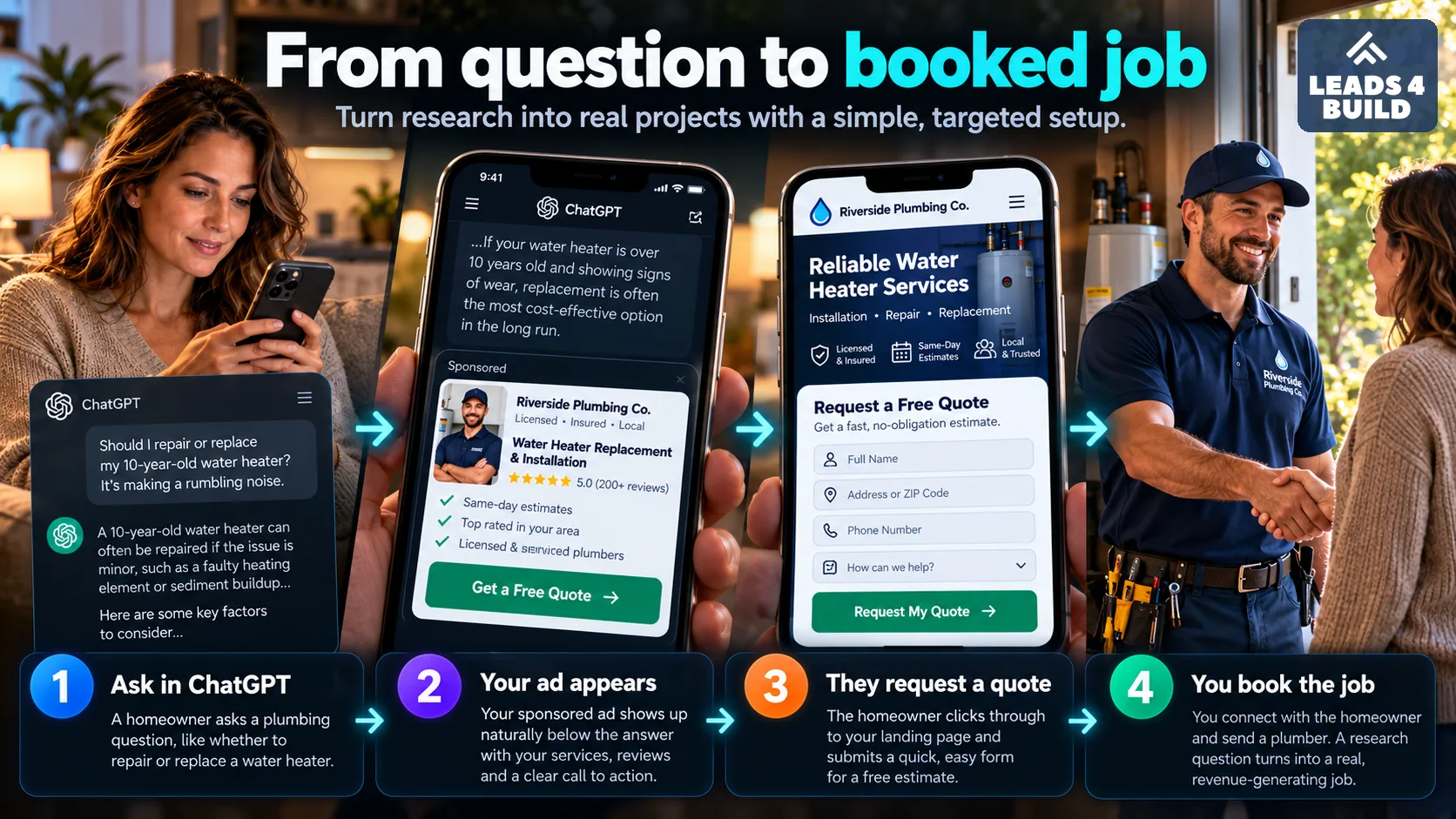
- A tap-to-call phone number at the top, before any text, using a tracking number used only on ChatGPT pages.
- The job named in the headline, matching the ad: “Water heater replacement in Tempe,” not “Welcome to our plumbing company.”
- The prices they were just asking about: installed ranges, your service-call fee, and how soon you can come.
- A short form (job, ZIP code, how urgent) for people who can’t talk right now, and your license number and reviews near the phone number.
Never send the ad to your homepage; OpenAI asks for “product pages, collections, or content pages rather than defaulting to a generic homepage.” Check that robots.txt does not block OAI-AdsBot or OAI-SearchBot. Our guide to lead generation landing pages goes through the layout in more detail.
License numbers and price claims
OpenAI’s rules. Local services are an accepted category in OpenAI’s ad policies (updated September 10, 2026). Ads must be “truthful and not misleading, including unfounded claims about capabilities, pricing, outcomes.” The same policy says advertisers whose services need a license “must maintain those credentials and comply with applicable laws and regulations.”
State licensing rules. Some states regulate plumbing ads directly. Texas is a clear example: its plumbing board rule says a company “shall ensure that all advertisements by a plumbing company designed to solicit plumbing business state the license number of the RMP of record, regardless of the type of media used” (22 Texas Administrative Code 367.10). The exemptions cover things like radio and phone calls, not online ads with a visual part. If your state has a rule like this, ask your licensing board how it applies to a short online ad, and show the number on every landing page. This is not legal advice.
Count booked jobs from calls, not clicks
Most plumbing leads are phone calls, and OpenAI’s tools see the click better than the call. Set this up before spending anything:
- UTM parameters on every ad link. OpenAI says they “persist on ad clicks,” so your analytics and CRM can tag the visit as ChatGPT Ads.
- A dedicated call tracking number on the ChatGPT landing pages, so every call from that traffic is counted and recorded.
- The OpenAI Pixel for form leads. OpenAI’s developer docs say to use the standard “lead_created” event “for a lead submission.”
- Booked calls through the Conversions API, if you can. A developer or call tracking integration can send a server event when a call books a job, with the “oppref” click reference included, per OpenAI’s measurement guide; the API “does not capture this value automatically.” If nobody can build that, count booked calls in your CRM.
- Exclude your existing customers. Custom audience inclusion needs at least 25,000 matched users, but OpenAI says exclusions “can use smaller audiences,” so a list of your past customers can keep you from paying for clicks from people who already have your number.
OpenAI says its numbers and your analytics “may report different conversion totals.” Decide in advance which one is the scorecard; for a plumber, booked jobs in the CRM.
If your source tracking is loose today, a low-tech version works for a 30-day test. Add a lead source such as “ChatGPT Ads: water heater” in ServiceTitan, Housecall Pro or whatever you book in; have the dispatcher and the answering service pick it whenever a call comes in on the ChatGPT number; and have one person update a weekly sheet with spend, clicks, calls, forms, booked jobs, completed jobs, sold revenue and gross profit.
A 30-day plumbing test, judged against your LSA numbers
OpenAI has not published plumbing results, and 150 to 250 clicks give a direction, not a verdict. Big jobs are rare in a small sample: if the calls are real homeowners in your area but only one or two sewer or repipe estimates came in, extend the test to 45 or 60 days and judge it on sold revenue rather than calling it after 30.
Should your plumbing company test ChatGPT Ads now?
| Test now if… | Wait if… |
|---|---|
| You know your LSA cost per lead and per booked job | You can’t say what a Google lead costs you |
| You do water heaters, sewer lines, repipes or tankless installs | Most of your revenue is emergency drain and leak calls |
| You have separate pages for those jobs with real prices | Every ad would go to your homepage |
| Calls are tracked by source and booked jobs are in a CRM | Calls come in on one number and nobody logs the source |
If you are on the “wait” side, fix the Google side first; our plumbing PPC and lead generation services page explains how we run Search and Local Services Ads for plumbers. Being named in ChatGPT’s answers for free is a separate job, done through reviews, listings and clear service pages, which we cover under AI SEO.
The bottom line
For plumbers, ChatGPT Ads are not an emergency channel yet: no call button, no hour schedule, uneven daily delivery. They are a fair test for jobs homeowners research first, like water heaters, sewer lines and repipes. Build ad groups around those jobs, send clicks to pages that make calling easy, and judge cost per booked job against your Local Services Ads. For the general setup and other trades, see our ChatGPT Ads guide for home services; if you sell to businesses, see the B2B version.
Plus one free tool from us, unrelated to ads: we built an AI social media post generator for plumbing companies that writes job, tip and seasonal posts for Facebook and Instagram. It is free and one of 21 trade generators on our tools page.
About the sources: OpenAI settings come from its Ads Manager help center (campaigns, context hints) and ad policies, re-checked October 24, 2026. Plumbing cost per lead figures are SearchLight Digital’s published client data (LSA benchmarks). Other sources are linked where each fact appears.