

Most landscaping companies running Google Ads have the same setup: one campaign, every service crammed together, same budget every month. Lawn care, tree trimming, hardscaping, snow removal, all in a single bucket. If that sounds like your account, you’re not alone. It’s costing you thousands.
A one-campaign-fits-all structure gives you zero visibility into what’s generating jobs and what’s burning cash. You can’t optimize what you can’t measure, and you can’t measure anything when every service, audience type, and season is tangled together.
This is the structural playbook for Google Ads for landscapers. Not theory, not a list of “tips.” The exact campaign architecture, budget allocation, and seasonal adjustments that separate companies booking $50K months from those wondering why the phone stopped ringing.
Why Your Google Ads Account Is Set Up to Fail (And It’s Not Your Fault)
The most expensive myth in landscaping advertising: “I just need one campaign with all my services and Google will figure it out.”
Google will figure it out, all right. It’ll figure out which keyword is cheapest to trigger, push your budget there, and call it optimization. That might mean 80% of your spend goes to “lawn mowing near me” clicks at $3 each while your $8,000 hardscaping jobs never get a chance to compete.
The reality is simpler and uglier than most agencies will tell you. One campaign means one pool of data. You can’t see which service converts, which keyword wastes money, or which audience type (residential vs. commercial) actually fills your schedule. According to LocaliQ (2021), the median cost per lead for landscaping search advertising was $88.47, but with a single-campaign setup, you can’t even tell if you’re above or below that number at the service level.
Your tree service leads might cost $45 each and close at 30%. Your hardscaping leads might cost $140 and close at 15%, but generate five times the revenue per job. Without campaign-level separation, those numbers are invisible.
The fix starts with breaking your account into segments that mirror how your business actually operates: by service line, by customer type, by season. Every dollar becomes traceable, and Google’s algorithm finally has clean signals to optimize against.
Conversion Tracking Comes Before Everything Else
Don’t spend another dollar until you can answer this question: do you know exactly which clicks turn into real leads?
If not, fix tracking first. Smart Bidding, campaign structure, ad copy testing: none of it matters if Google doesn’t know what a conversion looks like in your account.
What counts as a conversion for a landscaping company:
- Phone calls lasting 60 seconds or longer (short calls are usually spam or wrong numbers)
- Form submissions that reach a thank-you page
- Quote request completions that actually come through your CRM
What does NOT count: pageviews, time on site, scroll depth, bounce events. These are vanity metrics. They tell Google to optimize for browsers, not buyers.
Your setup checklist:
- Install Google Tag Manager on every page
- Set up a call tracking number through CallRail or Google’s forwarding number
- Create a dedicated thank-you page for each form and track it as a destination conversion
- Verify every conversion action fires correctly; test it yourself before going live
- Import offline conversions if you’re tracking closed deals in a CRM
Smart Bidding algorithms are only as good as the conversion signal you feed them. Garbage tracking in, garbage optimization out. Get this right first.
Commercial vs. Residential: Two Different Businesses Inside One Ad Account
A property manager searching “commercial landscaping contracts” and a homeowner searching “lawn care near me” have almost nothing in common. Different intent. Different budget. Different decision timeline. Different reasons to pick you.
Yet most landscaping Google Ads accounts treat them as the same audience.
The differences matter in every part of your account:
| Factor | Residential | Commercial |
|---|---|---|
| Keyword themes | “lawn care near me,” “landscaper in [city]” | “commercial landscaping company,” “HOA landscape maintenance” |
| Average job value | $150–$500 per visit | $2,000–$15,000+ per contract |
| Conversion timeline | Days; they want someone this week | Weeks to months; RFPs, bids, approvals |
| Decision maker | Homeowner | Facilities manager, property manager, HOA board |
| Message angle | Speed, price, reviews, before/after photos | Reliability, contract terms, fleet size, insurance |
When you run both in the same campaign, your residential headline (“Affordable Lawn Care, Book Today”) shows up for a facilities manager evaluating a $50,000 annual contract. That ad doesn’t get clicked. Or worse, it does, the visitor bounces, and you’ve paid for nothing.
The structural fix: separate campaigns with separate budgets, ad copy, and landing pages. Your residential landing page should show price ranges, reviews, and a “get a free estimate” form. Your commercial page needs case studies, contract details, and a consultation CTA. We cover what each of those pages needs in our guide to landscaping landing pages. (We cover similar audience segmentation in our Google Ads for Remodelers guide.)
For budget allocation, follow your current revenue mix. If 70% of revenue is residential, put 70% of your budget there. Rebalance after 60–90 days once you have real CPL data by segment.
LSA and Search Ads Are Not the Same Tool, Use Both
“Should I run Local Service Ads or regular Google Ads?”
Both. They do different things.
Local Service Ads (LSAs) sit at the very top of Google results with a Google Guarantee badge. You pay per lead, not per click. You don’t control keywords or ad copy; Google matches you based on service categories and location. The trust signal is powerful for residential customers making fast decisions.
Search Ads sit below LSAs. You control keywords, ad copy, landing pages, and bids. You get granular data on which search terms trigger your ads and which convert. This is where you run targeted campaigns for specific services like hardscaping or commercial maintenance.
They don’t cannibalize each other. LSAs capture the “I need someone now” buyer. Search Ads capture the “I’m comparing options” buyer. Different mindset, different funnel position, same person on different days.
Start with 30–40% of your digital ad spend on LSA. Run both channels for 60 days, then compare CPL by service type. Some landscaping companies find LSA delivers cheaper leads for lawn care but Search outperforms for higher-ticket services. You won’t know until you measure both.
The Sub-Niche Problem: Each Service Has Its Own Google Ads Economics
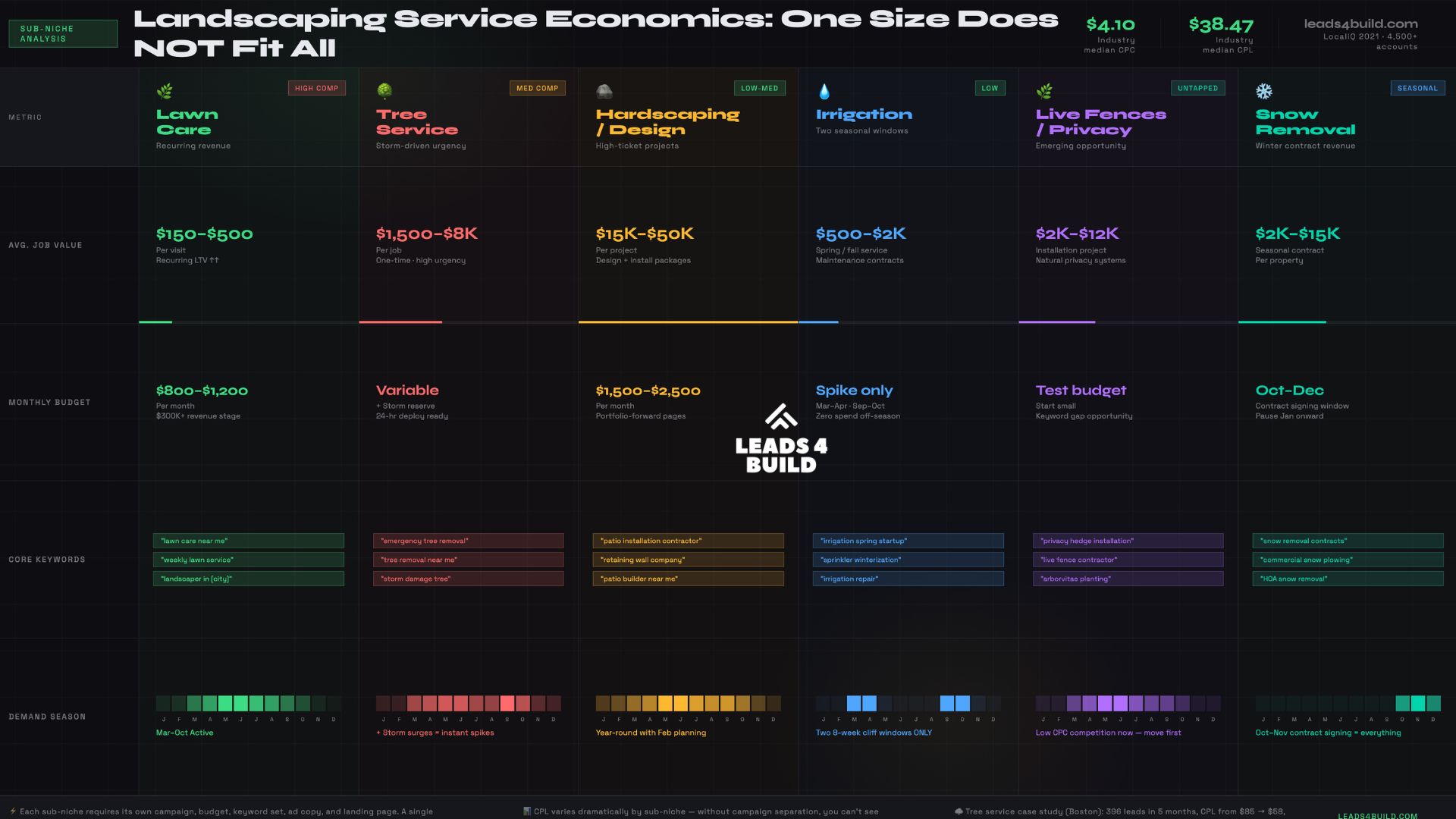
This is where most “Google Ads for landscapers” advice falls apart. Generic recommendations ignore the fact that lawn care, tree service, hardscaping, irrigation, and snow removal each operate on completely different economics. One campaign cannot serve all of them — and the numbers prove it.
Lawn Care
High volume, recurring revenue, fierce competition. CPCs are moderate because the keyword pool is large, but you’re competing against national franchises and every local operator within 20 miles.
A $300K lawn care company should budget $800–$1,200/month. Focus keywords around maintenance and subscription framing. “Weekly lawn care service” outperforms “lawn mowing” because it signals the high-LTV customer you actually want.
Tree Service
Storm damage drives this sub-niche. When a branch falls through someone’s fence at 2 AM, they’re searching “emergency tree removal” on their phone, and they’ll call the first company that looks credible.
Expect higher CPCs because urgency intent commands premium auction pricing. Your negative keyword list is critical: “tree service” pulls in job seekers, arborist certification searches, and DIY tutorials. Seasonality spikes in spring and after major storms; keep a reserve budget you can deploy within 24 hours when weather hits.
We ran a Google Ads campaign for a solo arborist in the Greater Boston area with zero brand presence, no website, and no existing customers. Over five months, we generated 396 Google Ads leads at a starting CPL of $85, which we brought down to $58 through structured optimization. By month five, the account was producing 280+ leads per month, the team had grown from one arborist to a five-person crew, and the business was booked two weeks in advance. The full breakdown is in our Tree Service Advertising Case Study.
Hardscaping / Design-Build
The highest CPL tolerance of any landscaping sub-niche, and that’s fine. A single patio installation or retaining wall project can run $15,000–$50,000. You can afford to spend more per lead.
Budget $1,500–$2,500/month. The sales cycle is longer; these buyers research for weeks and request multiple consultations. Landing pages need to be portfolio-forward with project photos and a clear consultation booking process. Keywords: “patio installation contractor,” “retaining wall company near me.”
For more on positioning and lead generation for this sub-niche, see our guide to hardscaping marketing.
Irrigation
You have two windows. March to April for spring startup. September–October for fall winterization. Outside those eight weeks, search volume drops to near zero.
Don’t fight the calendar. Spike your irrigation budget during those peaks, then reallocate those dollars to other service campaigns in the off-months. Irrigation is one of the clearest arguments against flat monthly budgets — the demand curve is practically a cliff on both sides.
Live Fences / Privacy Hedges
Most of your competitors aren’t running campaigns here yet, and that’s exactly why you should be. Homeowners and commercial properties searching for natural privacy solutions represent a growing market with lower CPC competition than established landscaping keywords.
The buyer is specific: someone who wants privacy but doesn’t want a wooden fence. They’re searching “privacy hedge installation” and “live fence contractor,” and finding almost no dedicated ad campaigns. This is an opportunity to dominate a keyword gap before competition catches up. Run a small dedicated campaign and test demand in your market.
Snow Removal
While the rest of your campaigns wind down for winter, snow removal is ramping up. Start in October, push hard through November and early December while contracts are still being signed, and pause by January once your routes are full.
Snow removal is contract-based and high-urgency. A property manager searching in November needs someone locked in before the first snowfall. Your ads should emphasize reliability, fleet capacity, and contract availability, not price. This campaign must be separate from your other services because it runs when everything else is winding down.
The bottom line: one campaign cannot serve all of these sub-niches. Each one deserves its own budget, keyword set, ad copy, landing pages, and seasonal schedule. Anything less, and you’re subsidizing your worst-performing service with revenue from your best one.
Build a Campaign Structure That Gives You Control
Strategy without structure is just intention. This is how you organize your account so every dollar is traceable and every optimization decision is backed by clean data.
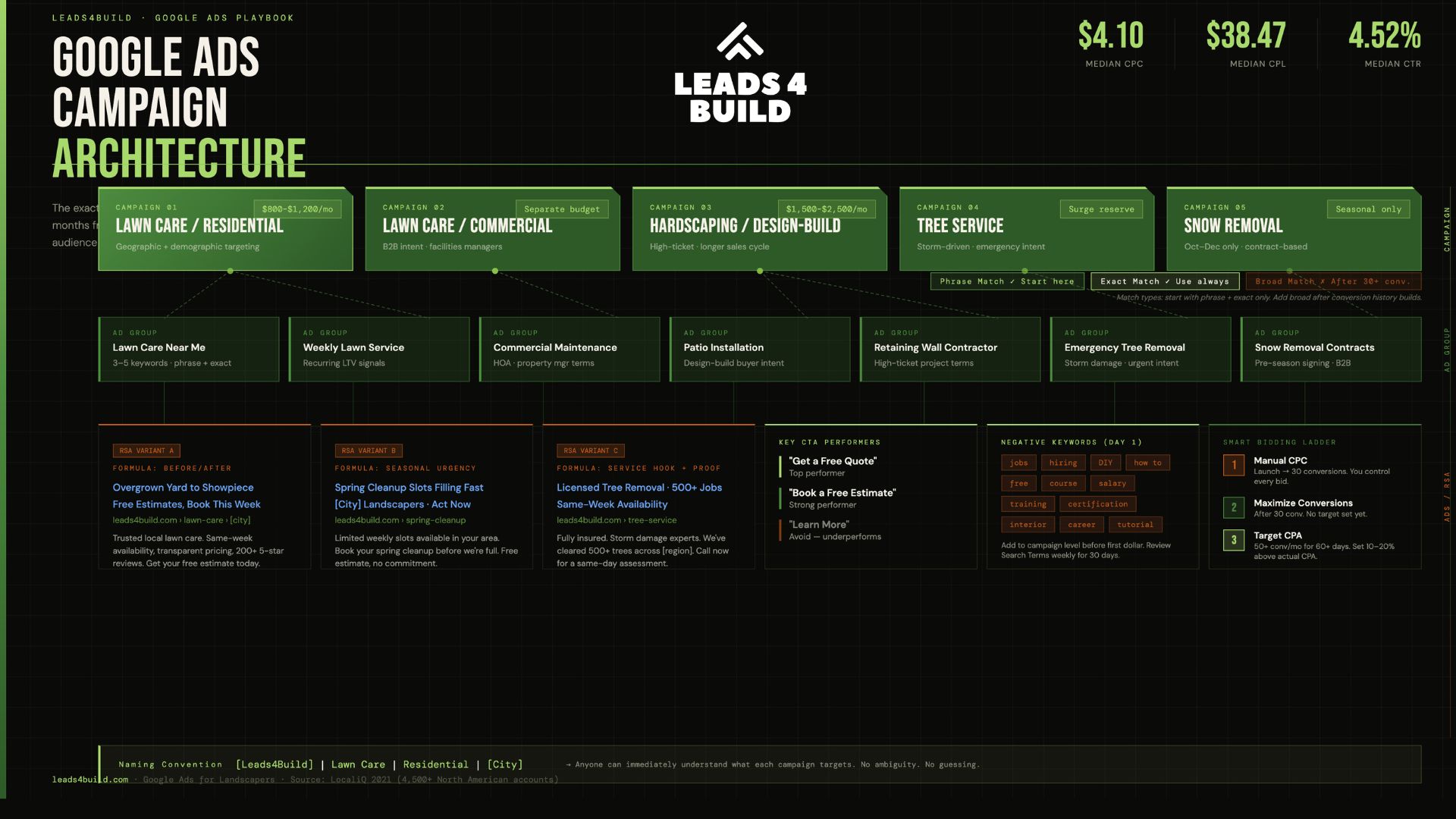
Campaign level: Segment by sub-niche AND audience type. “Lawn Care / Residential” is one campaign. “Lawn Care / Commercial” is another. Each gets its own daily budget and bidding strategy.
Ad group level: Three to five closely related keywords per ad group, maximum. “Patio installation,” “patio contractor,” and “patio builder near me” belong together. “Patio installation” and “retaining wall contractor” do not. Tight ad groups mean your ad copy matches search intent, which drives higher Quality Scores and lower CPCs.
Ad level: Three responsive search ads per ad group, each testing a different value proposition: speed, quality/portfolio, or price transparency. Pause the lowest performer after collecting statistically meaningful data.
Naming convention: [YourBusinessName] | Lawn Care | Residential | [City] so anyone can immediately understand what each campaign targets.
For match types, start with phrase match and exact match only. Broad match can work after you’ve accumulated conversion data, but running it on day one with no history is how you end up paying for “landscaping degree programs” and “lawn care jobs hiring.”
According to LocaliQ (2021), the median CPC for landscaping search advertising was $4.10 — though costs vary by sub-niche, geography, and competition level, and have trended higher in subsequent years. With proper structure, you’ll see exactly where your CPCs fall by service, audience, and geography.
Start with your two or three highest-margin services. Prove the CPL, then expand. Launching eight campaigns at once with a limited budget dilutes data and delays optimization.
Seasonal Budgets: Stop Spending the Same Amount Every Month
Landscaping is one of the most seasonal industries in existence. Spending the same dollar amount in January as you do in May is not a strategy; it’s an accounting default that ignores how your customers actually buy.
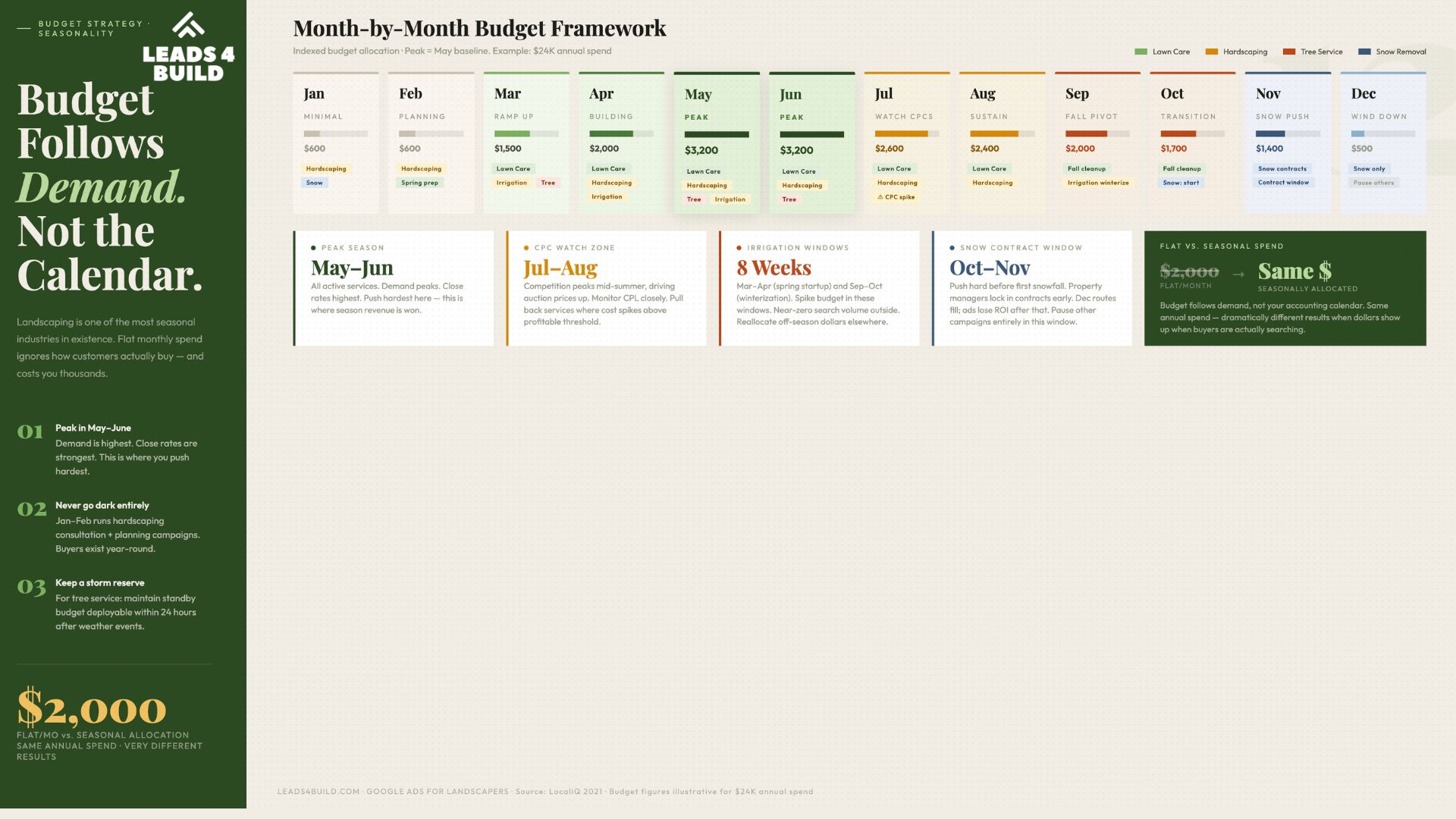
The seasonality is clear in Google Trends data for landscaping keywords: search interest peaks sharply in early summer and falls significantly through the fall and winter months. For a broader view of market size and demand patterns, see our landscaping industry statistics report. Your budget should reflect that reality.
A seasonal framework that works for most landscaping businesses:
- January–February: Minimal spend. Run hardscaping consultation campaigns for spring projects and snow removal if applicable. This is planning season, not buying season.
- March–April: Ramp up. Irrigation spring startup, lawn care season kickoff, spring cleanup. Buyers are re-engaging. Increase budget 50–75% above your winter baseline.
- May–June: Peak budget. All active services running at full capacity. Push hardest here; demand is high and closing rates are strong.
- July–August: Sustain, but watch CPCs. Competition peaks mid-summer, which drives auction prices up. Monitor cost per lead closely and pull back on services where CPL spikes above profitable thresholds.
- September–October: Fall cleanup campaigns activate. Irrigation winterization launches. Hardscaping projects for “before winter” buyers. Budget stays moderate.
- November–December: Wind down to snow removal only. Pause or dramatically reduce all other service campaigns.
The math: $2,000/month flat vs. $800 in January, $1,500 in March, $3,200 in May, $600 in December. Same annual spend. Very different results, because your dollars show up when buyers are actually searching.
Budget follows demand, not your accounting calendar.
Writing Ads That Actually Get Clicked by Landscaping Customers
According to LocaliQ (2021), the median click-through rate for landscaping search ads was 4.52% — and top-performing accounts consistently do better than that. The difference between ads that blend into the page and ads that compel action comes down to three copy formulas.
Before/After: Show the transformation.
“Overgrown Yard to Showpiece / Free Estimates, Book This Week”
Homeowners visualize the outcome. Pair it with ad extensions showing project photos when available.
Seasonal Urgency: Create a deadline.
“Spring Cleanup Slots Filling Fast / [City] Landscapers, Act Now”
Urgency works because capacity is genuinely limited. You can only take so many jobs per week.
Service Hook + Proof: Lead with credibility.
“Licensed Tree Removal / 500+ Jobs, Same-Week Availability”
Numbers build trust instantly. Job count, years in business, review count: pick your most impressive proof point and put it in the headline.
For RSAs, load eight to ten headline variants testing all three formulas. Let Google rotate combinations for two to three weeks, then pin your highest-performing headlines to positions one and two.
CTAs matter more than you think. “Get a Free Quote,” “Book a Free Estimate,” and “See Pricing” dramatically outperform “Learn More” or “Contact Us.” Landscaping customers with commercial intent want a price conversation, not an educational experience.
Smart Bidding Without Enough Data Is Just Gambling
Turning on Target CPA or Maximize Conversions the day you launch a new campaign feels like the smart move. Google recommends it. Your account rep recommends it. It’s not.
Smart Bidding uses machine learning to adjust bids based on conversion patterns. That’s powerful when patterns exist. On a new campaign with zero history, the algorithm has nothing to learn from. It guesses. And Google’s guesses with your money tend to be expensive.
The progression that actually works:
- Start with Manual CPC. Set bids yourself. Control spend tightly. Collect data.
- After 30 conversions in a campaign: Switch to Maximize Conversions with no target set. Let the algorithm use your real conversion data to find more of the same.
- After 50+ conversions per month for 60+ days: Move to Target CPA with a conservative target, setting it 10–20% above your actual CPA to give the algorithm room to perform.
In our experience, Smart Bidding strategies need at least 30–50 conversions per month at the campaign level to outperform manual bidding consistently. Be patient. Build the data. Then let automation take over.
Performance Max and AI Max. What to Know Before You Touch Them
Performance Max and AI Max campaigns can deliver strong results for landscaping companies. They can also drain your budget if you launch them without the right foundation.
These campaign types use Google’s AI to serve ads across Search, Display, YouTube, Gmail, Maps, and Discovery from a single campaign. You give up granular control in exchange for broader reach and automated optimization.
Before you launch PMax, check these minimums:
- Customer match list: Upload past client emails and phone numbers. You want 1,000+ records for meaningful signal.
- Website remarketing audience: At least 500 unique visitors in the last 30 days.
- Conversion history: 50+ conversions across your account in the last 90 days.
Without these signals, Performance Max doesn’t know who your ideal customer looks like. It finds audiences through trial and error, at your expense.
The recommendation is straightforward: run Search campaigns and LSA first. Build your conversion history, grow your remarketing audiences, and compile your customer list. Then layer PMax on top as an expansion channel. We’ll cover this in depth in a dedicated [Performance Max guide for landscaping companies (coming soon)].
Negative Keywords: The Fastest Way to Stop Wasting Money Right Now
Landscaping keywords are magnets for irrelevant traffic. Broad and phrase match pull in job seekers, DIY enthusiasts, and people searching for landscaping courses. Every one of those clicks costs you money and generates zero leads.
Add these as campaign-level negatives before your first dollar is spent:
Job seekers: jobs, hiring, career, employment, salary, wage, apprentice, internship
DIY and informational: how to, DIY, free, tutorial, course, training, certification, school
Unrelated: interior design, home decor, gardening tips, plant identification
That’s your starter list. It’s not complete.
For the first 30 days after launch, check your Search Terms report every week. You’ll find searches you never anticipated, and some will surprise you. Add negatives aggressively. A landscaping account we audited last quarter was spending $400/month on clicks from people searching “landscaping business for sale.” Those clicks weren’t just wasted; they were actively teaching Google’s algorithm to find the wrong audience.
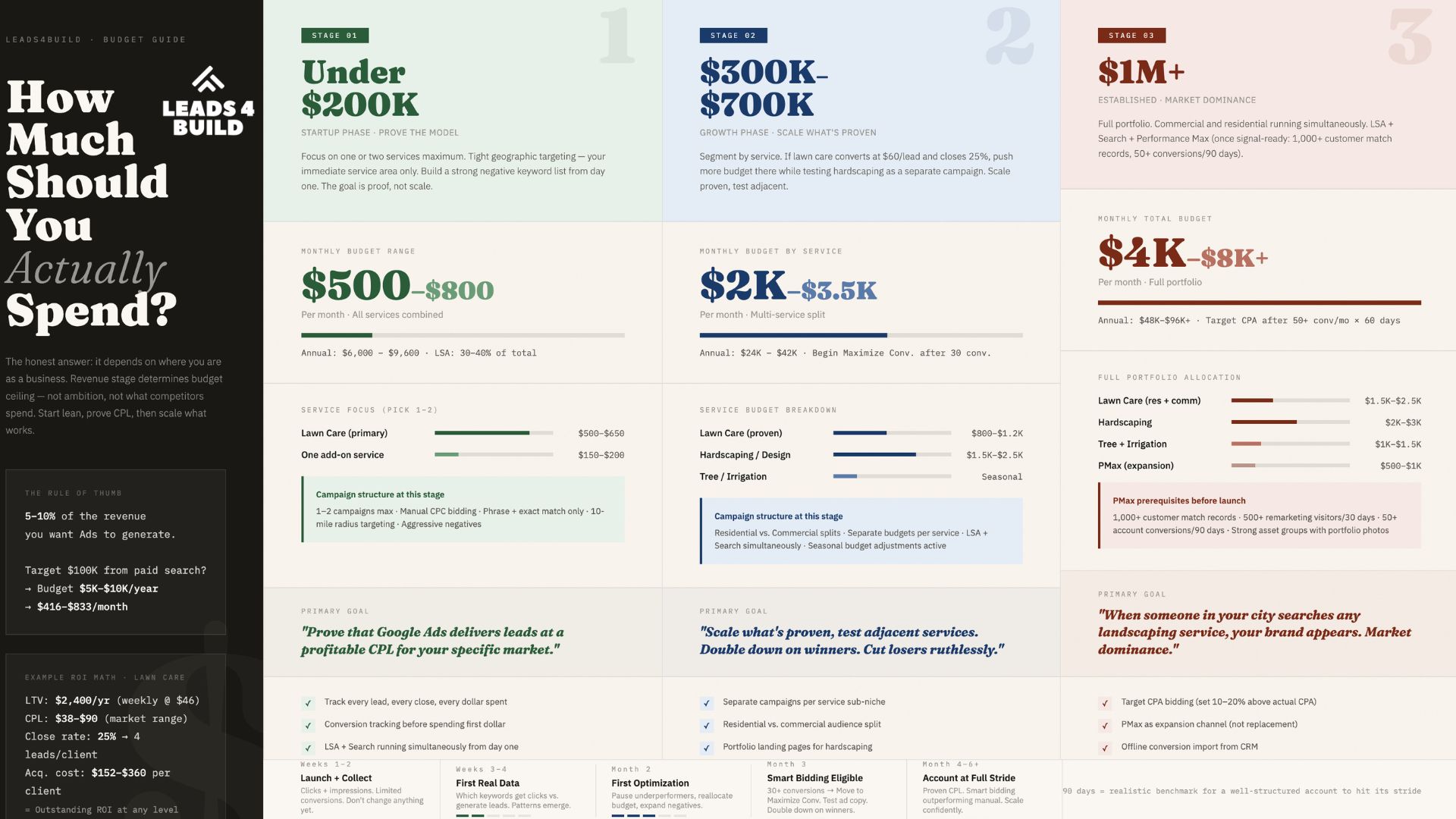
How Much Should Landscapers Actually Spend on Google Ads?
The most common question we get. And the honest answer is: it depends on where you are as a business.
According to LocaliQ (2021), the median CPC for landscaping search advertising was $4.10 and the median CPL was $38.47, based on data from over 4,500 North American accounts. Your actual costs depend on market, competition, sub-niche, and account structure — and costs have risen since this data was collected.
Budget ranges by business stage:
Startup / Under $200K Revenue: $500–$800/month
Focus on one or two services maximum. Keep your geographic targeting tight: your immediate service area only. Build a strong negative keyword list from day one.
The goal at this stage is not scale. It’s proof. You’re proving that Google Ads can deliver leads at a cost that makes sense for your business. Track every lead, every close, every dollar.
Growth Stage / $300K–$700K Revenue
This is where you start segmenting by service:
- Lawn care: $800–$1,200/month
- Hardscaping / design-build: $1,500–$2,500/month
- Multi-service campaigns: $2,000–$3,500/month
The goal here: scale what’s proven, test adjacent services. If lawn care is converting at $60/lead and closing 25% of estimates, push more budget there while testing hardscaping as a separate campaign.
Established / $1M+ Revenue: $4,000–$8,000+/month
Full portfolio. Commercial and residential running simultaneously. LSA plus Search plus Performance Max (once signal-ready). Multiple service-specific campaigns across your entire geography.
The goal: market dominance. When someone in your city searches for any landscaping service, your brand appears.
A rule of thumb: allocate 5–10% of the revenue you want Google Ads to generate. If you want $100,000 in annual revenue from paid search, budget $5,000–$10,000 per year, or roughly $400–$850 per month.
Run the profitability math for your business. If your average lawn care customer has a lifetime value of $2,400 per year (weekly service at ~$46/visit) and your cost per lead is $38–$90 depending on your market and sub-niche, you need roughly two to five leads to close one customer. Even at the high end, acquiring a $2,400/year client for under $200 in ad spend is outstanding ROI — and it tells you exactly how aggressively you should scale.
Is Google Ads Worth It for Landscapers?
Yes. With conditions.
Google Ads works for landscaping companies with a proven service, a website that doesn’t scare visitors away, and conversion tracking that fires. According to LocaliQ (2021), the median cost per lead for landscaping search advertising was $38.47, and with customer lifetime values well above $2,000 for recurring service clients, the math works strongly in your favor.
It doesn’t happen overnight. The realistic timeline looks like this:
- Weeks 1–2: Campaign launches. Data collection begins. You’ll see clicks and impressions but limited conversions. Don’t panic. Don’t change anything yet.
- Weeks 3–4: First meaningful conversion data arrives. You can see which keywords get clicks and which generate actual leads.
- Month 2: Patterns emerge. You identify which services and keywords drive your real cost per lead. First round of optimization: pause underperforming keywords, reallocate budget, expand negatives.
- Month 3: Enough data accumulates for Smart Bidding. You optimize aggressively, testing ad copy, adjusting bids, and doubling down on winners.
Ninety days is the realistic benchmark for a well-structured account to hit its stride.
When it doesn’t work, the reasons are almost always structural, not platform-related. No conversion tracking. One campaign for everything. Wrong match types flooding the account with irrelevant clicks. No negative keywords. Landing pages that look like they were built in 2011. Building landing pages that convert is a separate discipline, we cover the full framework in our lead generation landing pages guide.
Google Ads doesn’t fail landscapers. Poor account structure does. Fix the structure, and the platform performs.
FAQ: Google Ads for Landscaping Businesses
What is the best way to advertise a landscaping business?
Google Local Service Ads, Google Search Ads, and a strong Google Business Profile cover the highest-intent channels. LSAs build trust, Search Ads give you keyword control, and your Business Profile drives organic map visibility. Start with these three before social media or display ads.
How do landscapers get clients?
Google Ads (Search + LSA), referrals, and local SEO through Google Business Profile optimization. Door hangers and yard signs still work for hyperlocal awareness, but for predictable, repeatable lead flow, paid search outperforms everything else. For the full picture, check out our Landscaping Marketing: The Complete Guide.
What is the difference between LSA and Google Ads for landscapers?
Local Service Ads charge per lead and appear above all other results with a Google Guarantee badge; you don’t control keywords or ad copy. Standard Google Search Ads charge per click and give you full control over targeting, copy, and landing pages. Both should run simultaneously because they serve different buyer mindsets. See the detailed breakdown earlier in this guide.
Your Google Ads Account Should Work as Hard as Your Crews Do
The landscaping companies winning with Google Ads aren’t outspending their competition. They’re out-structuring them. While competitors dump everything into one campaign, the top performers segment by service, track every conversion, and shift budget with the seasons.
Three moves separate profitable accounts from money pits:
- Segment by service sub-niche. Each service has its own economics, keywords, and seasonal patterns. Treat them accordingly.
- Build conversion tracking before you spend. Every optimization decision downstream depends on clean data upstream.
- Match your budget to seasonal demand. Stop spending the same amount in January as you do in May.
If your current Google Ads account is one campaign with everything thrown together, you’re leaving money on the table every single day. If you want a full-channel approach beyond paid search, explore our landscaping digital marketing services. We audit landscaping Google Ads accounts and show you exactly where the waste is, which services are underperforming, and what a proper structure looks like for your specific business.