

You spent $4,000 on Google Ads last month. You got 22 leads. Fourteen were homeowners asking about $800 bathroom caulking jobs. Three were spam. Five were real remodeling prospects, and you closed one.
That’s a $4,000 cost per project.
The problem isn’t Google Ads. The problem is that your campaigns are set up to generate leads, not to book the kind of projects that actually grow your remodeling business. A $50K kitchen remodel and an $800 handyman call look identical to Google’s algorithm unless you teach it the difference.
This guide covers the full Google Ads ecosystem for remodeling contractors: campaign types most agencies never mention, keyword strategies that filter for project size, YouTube ads for brand building, offline conversion tracking that teaches Google what a real project looks like, and a budget scaling framework from $1,500/mo to $15,000/mo. (For context on where the industry is headed, see our home remodeling statistics breakdown.) No fluff. No “it depends.” Real numbers for remodelers who want high-end projects, not a flood of unqualified calls.
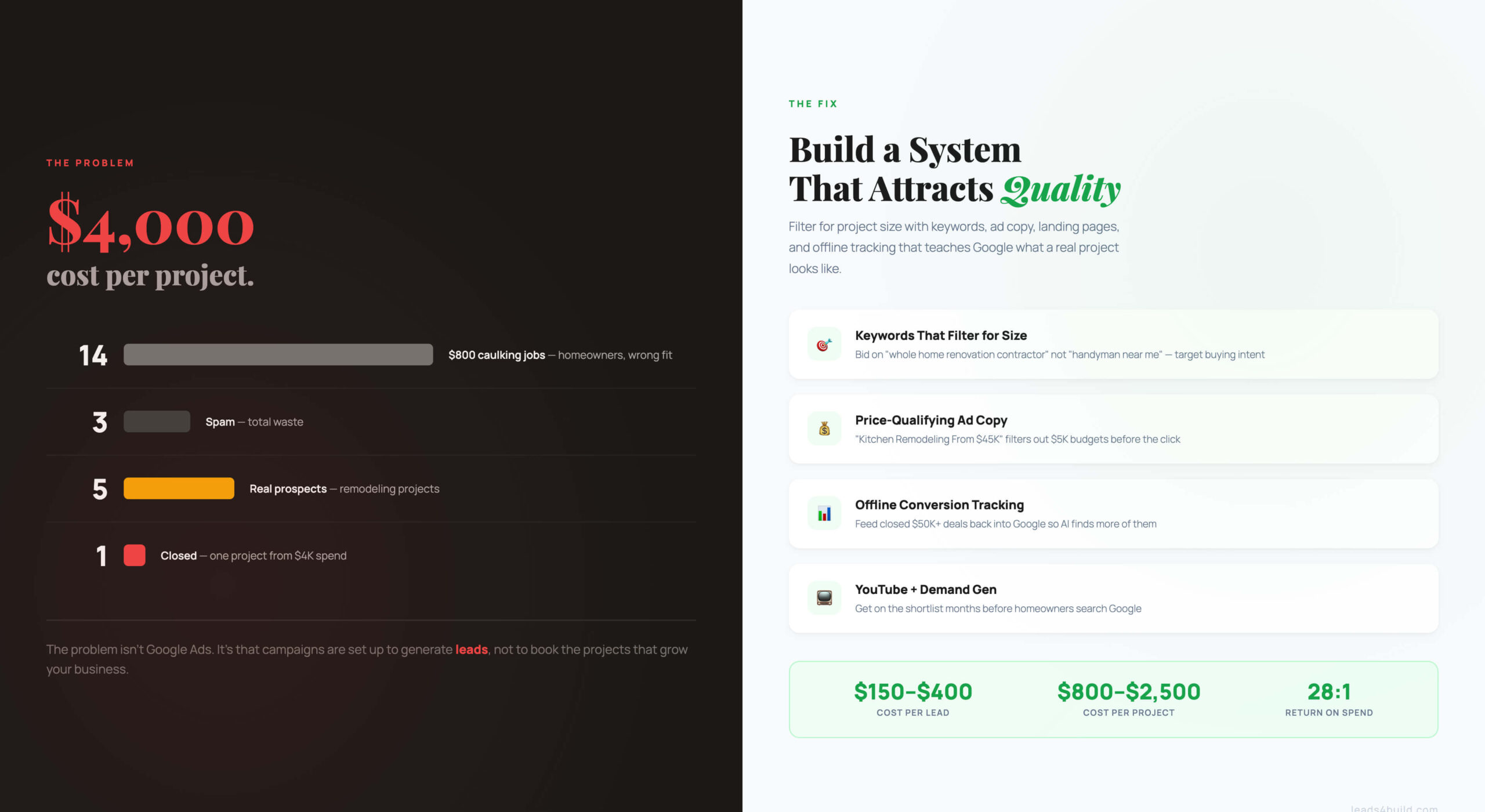
TL;DR: Google Ads for remodelers costs $1,500 to $15,000/mo depending on stage. Start with Search + LSAs to capture high-intent homeowners searching for remodeling services. Add YouTube and Demand Gen for brand awareness. Implement offline conversion tracking so Google optimizes for booked $50K+ projects, not just form fills. Expected CPL: $150 to $400. Expected cost per booked project: $800 to $2,500. The remodelers who win aren’t chasing cheap leads. They’re building a system that attracts quality leads and filters out everything else.
The Google Ads Ecosystem: More Than Just Search Ads
Most remodeling contractors think Google Ads means one thing: paying to show up when someone searches “kitchen remodeler near me.” That’s one campaign type out of six that matter for your business.
Here’s the full menu:
| Campaign Type | Best For | Cost Model | Remodeler Priority |
|---|---|---|---|
| Search | Capturing homeowners actively searching for remodeling services | Pay per click ($8–$18/click) | Stage 1 — start here |
| Local Services Ads (LSA) | Appearing above search ads with Google Verified badge | Pay per lead ($20–$85/lead) | Stage 1 — run alongside Search |
| Performance Max | AI-driven ads across all Google channels | Pay per click (varies) | Stage 2 — after baseline data |
| Display (Remarketing) | Bringing back visitors who left your site | Pay per click ($0.50–$3/click) | Stage 2 — remarketing only |
| YouTube / Video | Brand awareness, before-and-after showcases | Pay per view ($0.02–$0.10/view) | Stage 3 — brand building |
| Demand Gen | YouTube, Shorts, Discover, Gmail feed placements | Pay per click/view | Stage 3 — awareness at scale |
Search campaigns capture demand that already exists. Someone types “bathroom remodel contractor Phoenix” and your ad appears. That’s the foundation.

But here’s what every other Google Ads guide for remodelers misses: search campaigns only reach people who are already looking. For a $75,000 kitchen remodel, the decision process starts months before that search happens. The homeowner browses Houzz, watches renovation videos on YouTube, drives past your competitor’s yard signs, and talks to neighbors. By the time they search Google, they already have a shortlist in their head.
YouTube and Demand Gen put you on that shortlist before the search ever happens. Display remarketing keeps you there after they visit your site and leave (which 95% of them will). Performance Max lets Google’s AI find homeowners across every channel using signals from your converting customers.
The remodeling companies running only search ads are fishing in the smallest pond. The ones running full-funnel campaigns own the entire lake. (Need help building a full-funnel strategy? See our remodeling digital marketing services.)
Keyword Strategy: Targeting $50K Projects, Not $500 Repairs
The keywords you bid on determine the leads you get. Bid on “handyman near me” and you’ll get $200 fix-it jobs. Bid on “whole home renovation contractor” and you’ll get homeowners planning six-figure projects.
This isn’t complicated. It’s just deliberate.
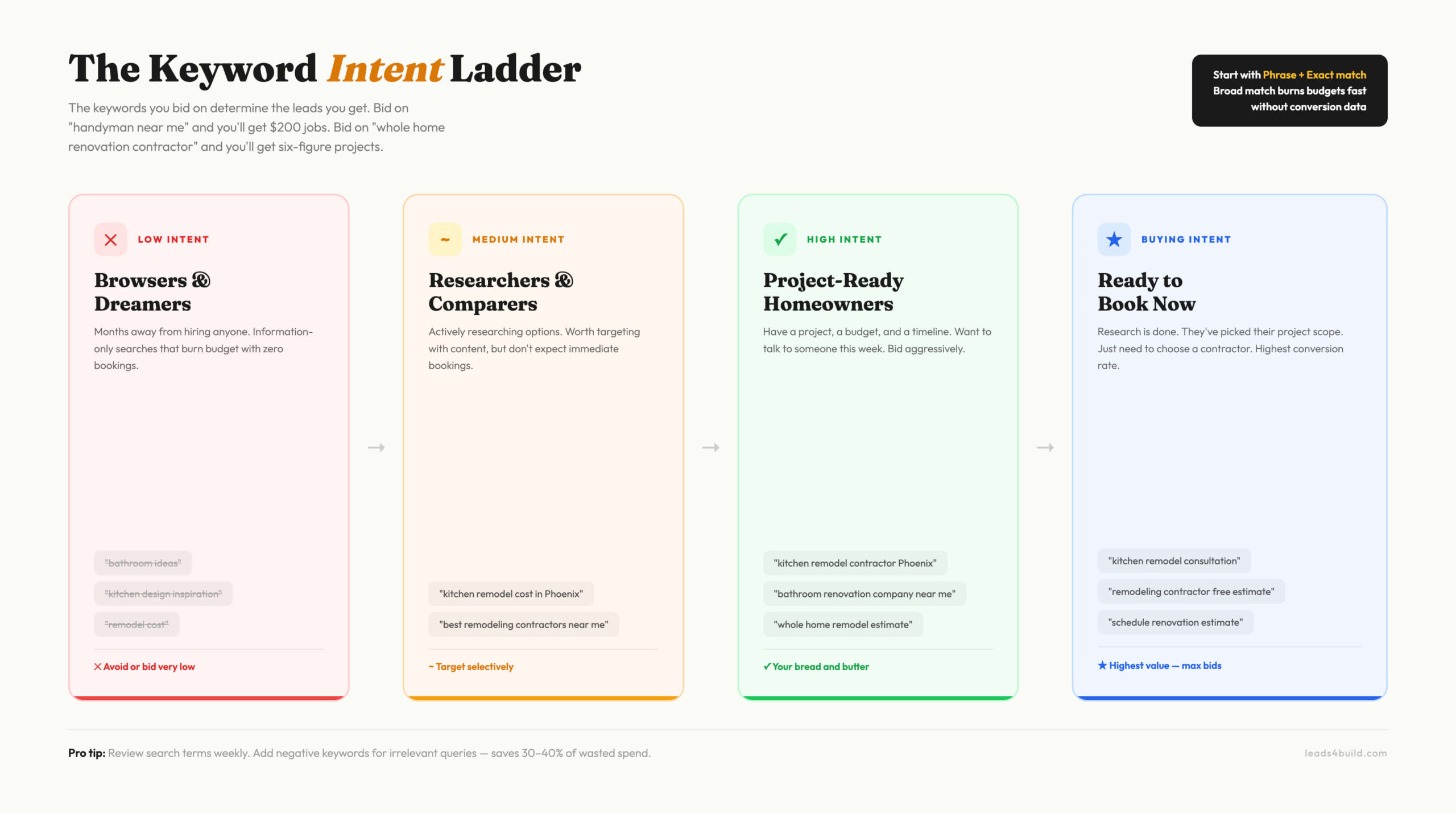
The Intent Ladder
Remodeling keywords fall on a spectrum from low intent to high intent:
Low intent (avoid or bid low): “bathroom ideas,” “kitchen design inspiration,” “remodel cost.” These are browsers. They’re months away from hiring anyone.
Medium intent (target selectively): “how much does a kitchen remodel cost in [city],” “best remodeling contractors near me.” These homeowners are researching. Worth targeting with informational content, but don’t expect immediate bookings.
High intent (your bread and butter): “kitchen remodel contractor Phoenix,” “bathroom renovation company near me,” “whole home remodel estimate.” These people have a project, a budget, and a timeline. They want to talk to someone this week. Bid aggressively on these.
Buying intent (highest value): “kitchen remodel consultation,” “remodeling contractor free estimate,” “schedule renovation estimate.” These homeowners are ready to book. They’ve done their research. They just need to pick a contractor.
Match types control how broadly Google matches your keywords to actual searches. Exact match [kitchen remodel contractor Phoenix] shows your ad only for that phrase or very close variations. Phrase match “kitchen remodel contractor” shows your ad when someone’s search includes that phrase. Broad match kitchen remodel contractor shows your ad for anything Google thinks is related, including “DIY kitchen remodel” or “kitchen remodel jobs hiring.”
Start with phrase match and exact match. Broad match burns through budgets fast unless you have strong negative keywords and enough conversion data for Google’s AI to work with.
Negative Keywords: Your Budget’s Best Friend
A remodeling contractor without a negative keyword list is handing Google a blank check.
Add these immediately: DIY, how to, jobs, hiring, salary, cheap, free, classes, training, certification, “near me” (for services you don’t offer), and every service you don’t provide. If you don’t do roofing, add “roofing” as a negative. If you don’t do commercial work, add “commercial.”
Check your search terms report weekly. Google will show you exactly what queries triggered your ads. You’ll find surprises. One of our clients discovered 30% of their ad spend was going to searches like “remodeling contractor salary” and “how to become a remodeler.” Those clicks cost $12 each and generated zero leads.
Fifteen minutes a week reviewing search terms and adding negative keywords can cut wasted spend by 30 to 40 percent.
Ad Copy That Qualifies Before the Click
Your ad has one job: get the right person to click and keep the wrong person from clicking. Every click costs $8 to $18. You want the homeowner planning a $75K kitchen remodel to click. You don’t want the person looking for a $200 faucet replacement.
Google’s responsive search ads give you up to 15 headlines (30 characters each) and 4 descriptions (90 characters each). Google tests different combinations and shows the versions that perform best.
Here’s what works for remodeling contractors:
Example Ad Set 1: Kitchen Remodeling
| Element | Copy | Chars |
|---|---|---|
| Headline 1 | Kitchen Remodeling From $45K | 27 |
| Headline 2 | Award-Winning Kitchen Design | 28 |
| Headline 3 | Free In-Home Consultation | 25 |
| Headline 4 | See Our Kitchen Portfolio | 24 |
| Headline 5 | Licensed & Insured Since 2008 | 28 |
| Description 1 | Full-service kitchen remodeling in Phoenix. Custom cabinets, countertops, and layouts. Book your free estimate. | 108 |
| Description 2 | From design to final walkthrough. See our before-and-after gallery and schedule a consultation today. | 99 |
Notice “From $45K” in headline 1. That’s deliberate. It filters out the homeowner with a $5K budget. They won’t click, and you won’t pay for that click.
Example Ad Set 2: Bathroom Remodeling
| Element | Copy | Chars |
|---|---|---|
| Headline 1 | Bathroom Renovation From $25K | 29 |
| Headline 2 | Custom Bathroom Remodeling | 26 |
| Headline 3 | Get a Free Design Consult | 25 |
| Headline 4 | See Before & After Photos | 25 |
| Headline 5 | 5-Star Rated Contractor | 23 |
| Description 1 | Complete bathroom renovation in [City]. Walk-in showers, custom tile, vanities. Licensed contractor with 150+ projects completed. | 121 |
| Description 2 | Your bathroom remodel, start to finish. Free in-home consultation. See our portfolio and book your estimate today. | 110 |
Same principle: “From $25K” in the headline tells the homeowner looking for a $3K tub swap that this isn’t for them. You save the click cost and attract the right project size.
Ad assets you should always run:
- Sitelinks: Portfolio, About Us, Kitchen Remodeling, Bathroom Remodeling (4 links to key pages)
- Call extension: Your phone number with call tracking
- Location extension: Your business address
- Image assets: Before-and-after project photos
- Callout extensions: “Licensed & Insured,” “20+ Years Experience,” “Financing Available”
Every asset gives Google more material to build compelling ads and takes up more space in search results, pushing competitors further down the page.
YouTube and Demand Gen: Build the Brand Before They Search
A $75,000 kitchen remodel isn’t an impulse purchase. The homeowner thinks about it for months. They browse Pinterest boards, scroll through Houzz, watch HGTV, and ask friends for recommendations. By the time they type “kitchen remodel contractor” into Google, they’ve already formed opinions about who they want to hire.
If you’re not in their world during those months of research, you’re competing as a stranger against contractors they already know and trust.
That’s what YouTube ads solve.
Why Awareness Matters for High-End Remodeling
Traditional lead gen works for emergency services. Your AC breaks, you search, you call the first result. Done.
Remodeling doesn’t work that way. The decision cycle is 3 to 12 months. Homeowners compare portfolios, read reviews, and build a mental shortlist long before they request estimates. The contractor who showed up in their YouTube feed with a stunning kitchen transformation video is already on that list. The one who only runs search ads is starting from zero.
Video Creative That Works
Three formats that drive results for remodeling contractors:
Project walkthroughs (60–90 seconds): Walk through a completed kitchen or bathroom remodel. Show the before state, the process, and the finished result. No script needed. Just your project manager or designer walking through the space, pointing out details. These feel authentic because they are.
Client testimonial clips (30–60 seconds): Homeowner on camera in their new kitchen talking about the experience. This is social proof that no amount of ad copy can replicate.
Design process videos (2–3 minutes): Show how you take a homeowner’s vision and turn it into a plan. This positions you as experts who think, not just contractors who build.
Targeting the Right Homeowners
YouTube’s targeting for remodelers is powerful:
- In-market audiences: Google identifies people actively researching home renovation. Target them directly.
- Custom audiences: Build an audience of people who visit Houzz, Architectural Digest, or competitor websites.
- Life events: Target homeowners who recently purchased a home. According to NAR’s Remodeling Impact Report, recent buyers are significantly more likely to undertake major renovations than long-term homeowners.
Explore our video ads services if you want a team handling production and targeting. The cost is remarkably low. YouTube ads run $0.02 to $0.10 per view. Ten thousand homeowners in your market see your before-and-after kitchen transformation for $200 to $1,000. Compare that to a radio ad spot at $500 to $2,000 that reaches mostly people who will never remodel anything.
When those homeowners eventually search Google for a remodeling contractor, they recognize your name. They click your ad. Your click-through rate goes up. Your conversion rate goes up. Your cost per booked project goes down. That’s how brand building and lead gen work together.
Landing Pages: Where Remodeling Leads Are Won or Lost
You’re paying $8 to $18 per click. If you send that traffic to your homepage, you’re converting roughly 1 to 3 percent of visitors into leads. That means 97 out of 100 paid clicks are wasted.
According to LocaliQ’s 2025 Search Advertising Benchmarks (analyzing 3,211 home services campaigns), the average conversion rate for construction and contractors is just 2.61%, while optimized landing pages in home services reach 5 to 15 percent.
The math: 100 clicks at $15 each = $1,500. Homepage at 2% conversion = 2 leads at $750 each. Dedicated landing page at 10% conversion = 10 leads at $150 each. Same spend, five times the leads.
What a Remodeling Landing Page Needs
Above the fold: Headline matching the ad they clicked (if the ad says “Kitchen Remodeling in Phoenix,” the page says “Kitchen Remodeling in Phoenix”), one stunning project photo, and a clear CTA button: “Get Your Free Estimate” or “Schedule a Consultation.”
Below the fold: Before-and-after gallery (3 to 5 projects), project price ranges (“Our kitchen remodels typically range from $45K to $120K”), your process timeline (design → permits → build → walkthrough), 2 to 3 client testimonials with names and project types, and your credentials (licenses, insurance, certifications, awards).
What to leave off: Your full navigation menu (distracts from the CTA), links to your blog (they’ll leave and never come back), pricing calculators that overwhelm the visitor.
Build separate landing pages for each major service. Your kitchen remodel page should show kitchen projects, kitchen testimonials, and kitchen pricing. A homeowner searching for bathroom renovation doesn’t want to see kitchens. For a deeper dive, read our guide to lead generation landing pages, or see our landing page design for contractors service.
Mobile matters more than desktop here. Over 60% of remodeling searches happen on phones. Your landing page needs a one-tap call button, fast load time (under 3 seconds), and a form that takes under 30 seconds to complete.
Local Services Ads: The Pay-Per-Lead Channel
Local Services Ads sit above standard Google Ads in search results. You don’t pay per click. You pay per lead, typically $20 to $85 depending on your market and service.
The big change: as of October 20, 2025, Google retired the “Google Guaranteed” badge and replaced it with “Google Verified.” The Verified badge confirms your license, insurance, and background check, but it no longer includes the money-back guarantee for customers. The badge still builds trust, and LSA leads still convert well.
Requirements to run LSAs: a verified Google Business Profile with 3+ star rating, state contractor license (where required), general liability insurance, and background check for the business owner.
The limitation for high-end remodelers: LSAs don’t link to your website. The customer sees your rating, reviews, and a “Message” or “Call” button. That’s fine for a plumber or locksmith. For a $75K kitchen remodel, homeowners want to see your portfolio, your process, and your design work before they call. LSAs will generate leads, but those leads still need to be sold.
Run LSAs as one channel in your Google Ads stack. They’re cost-effective for generating initial conversations, and the leads tend to be local and ready to talk. Pair them with local SEO services for organic visibility in the same map pack. Just don’t rely on them as your only paid channel.
Remarketing: Bring Back the 95% Who Didn’t Convert
Ninety-five percent of visitors leave your website without filling out a form or calling. That doesn’t mean they’re not interested. It means they’re not ready yet. They’re comparing contractors, checking portfolios, and thinking about their budget.
Remarketing puts your ads in front of those visitors as they browse other websites, watch YouTube, and scroll through their feeds.
Three remarketing tactics that work for remodelers:
Display remarketing shows banner ads featuring your best project photos to people who visited your site. These ads follow them across the Google Display Network. Cost per click is typically $0.50 to $3, much cheaper than cold search traffic.
YouTube remarketing shows your project walkthrough videos to people who visited your site but didn’t convert. Now they see your craftsmanship in motion. This is especially effective for high-end remodeling where visual trust matters.
RLSA (Remarketing Lists for Search Ads) lets you bid higher when someone who already visited your site searches for remodeling services again. They searched once, visited your site, left, and now they’re searching again. They’re further along the decision process. Bid 30 to 50 percent higher for these visitors because they convert at 2 to 3 times the rate of cold traffic.
Set frequency caps at 5 to 7 impressions per day per user. Beyond that, you’re annoying potential clients instead of staying top of mind.
Bidding Strategies: Let Google Work for You (or Against You)
Google offers two approaches to bidding: manual control and AI-driven smart bidding. Most remodeling contractors either micromanage every bid (wasting hours) or hand everything to Google’s AI too early (wasting money).
Here’s the progression that works:
Weeks 1–4: Manual CPC. Set your own bids for each keyword. This gives you control while you learn which keywords and ads generate real leads. Start with $10 to $15 per click for kitchen and bathroom terms in most markets.
After 30+ conversions: Maximize Conversions. Switch to this smart bidding strategy and let Google’s AI adjust bids in real time. Google uses hundreds of signals you can’t see (device, location, time of day, browser, search history) to predict which clicks will convert. But it needs data to learn. Switching too early, before 30 conversions, means Google is guessing.
After stable performance: Target CPA. Layer a target cost per acquisition on top of Maximize Conversions. Tell Google “I want leads at $200 each” and let the algorithm find them. If you set the target too low, Google will throttle your campaigns and show your ads less often. Set it at your actual target, not your dream target.
Advanced (with offline conversions): Target ROAS. Once you’re importing closed deals with revenue values back into Google Ads, switch to Target ROAS (Return on Ad Spend). Now Google optimizes for revenue, not just lead count. This is the endgame for high-end remodeling companies, and it connects directly to the next section.
Offline Conversions: The Secret Weapon for High-End Remodelers
This is the single most valuable tactic in this entire guide. And almost no remodeling company uses it.
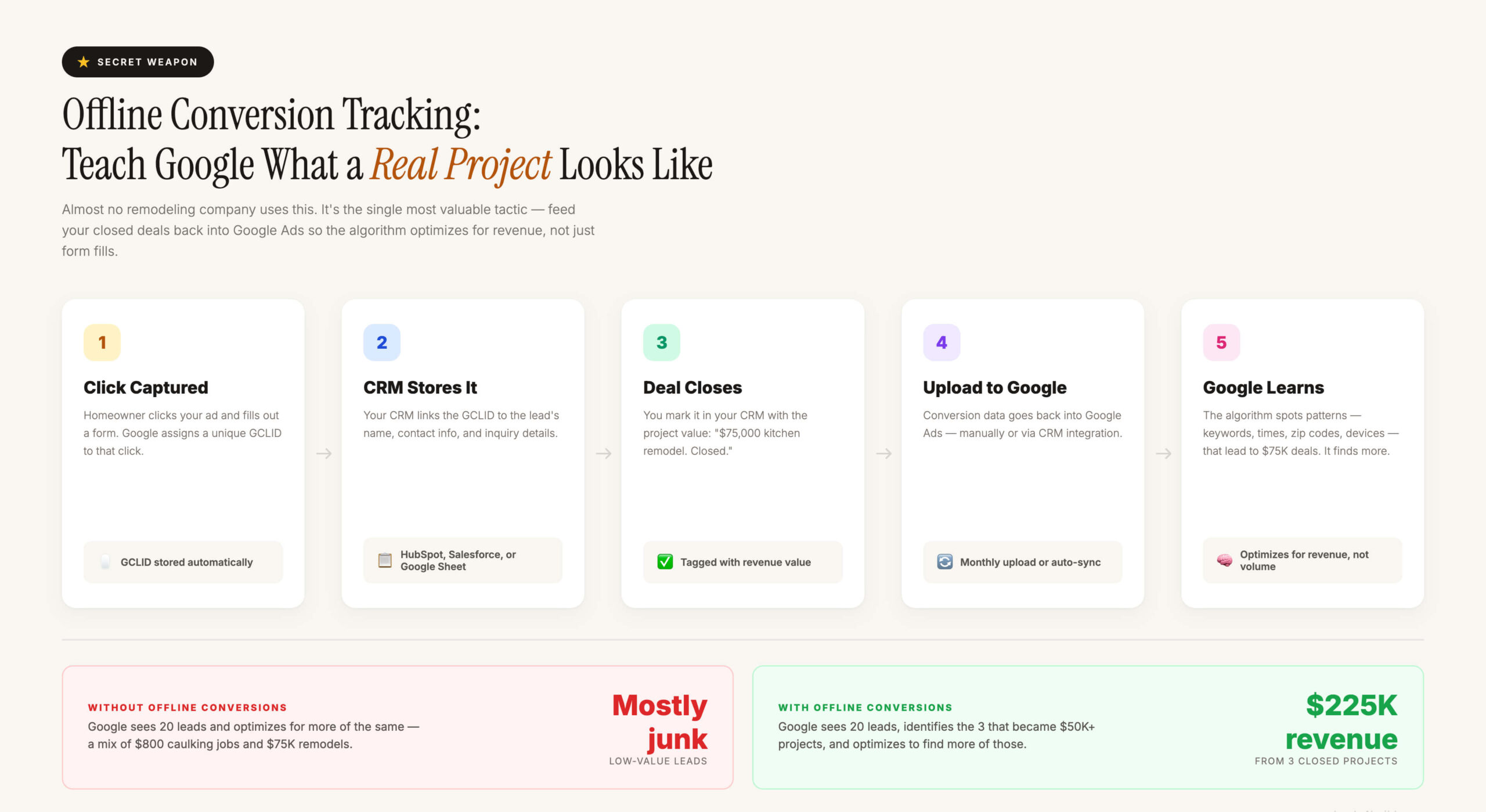
Here’s the problem: Google’s algorithm sees every form fill and phone call as equal. A homeowner asking about $800 worth of caulking and a homeowner requesting a $120K kitchen remodel look identical in your Google Ads dashboard. Google optimizes for volume, so it finds you more of whatever converts most easily. Usually, that’s the small jobs.
Offline conversion tracking fixes this by feeding your actual closed deals back into Google Ads.
How It Works
Step 1: When someone clicks your Google ad and fills out a form, Google assigns a unique ID (called a GCLID) to that click.
Step 2: Your CRM (HubSpot, Salesforce, even a Google Sheet) stores that GCLID alongside the lead’s information.
Step 3: When you close a deal, you mark it in your CRM with the project value. “$75,000 kitchen remodel. Closed.”
Step 4: You upload that conversion data back into Google Ads, either manually (monthly upload) or automatically through a CRM integration. Google now knows that the click from three months ago turned into a $75,000 project.
Step 5: Google’s algorithm learns the pattern. It notices that the clicks leading to $75K projects come from certain keywords, certain times of day, certain zip codes, certain devices. It adjusts your campaigns to find more of those clicks.
The Before and After
Without offline conversions, Google sees: 20 leads. Optimizes for: more leads like these (mix of $800 caulking and $75K remodels). Result: mostly low-value leads.
With offline conversions, Google sees: 20 leads, 3 of which became $50K+ projects generating $225K in revenue. Optimizes for: more clicks like those 3. Result: higher-quality leads, fewer time-wasters.
Call tracking tools like CallRail or WhatConverts make this even more powerful. Your receptionist tags each call as “qualified” or “unqualified” and notes the estimated project value. That data syncs back to Google Ads automatically. If you need help connecting your CRM to Google Ads, see our CRM and marketing automation services.
Connect Google Analytics 4 to your Google Ads account as well. GA4 shows the full journey: which campaigns drive consultations, which landing pages convert, and where visitors drop off. The combination of GA4 data, offline conversions, and call tracking gives you a complete picture of your ad performance that most remodeling companies never see.
No more guessing which campaigns drive real revenue. No more wasting money on clicks that generate calls from homeowners who want a $200 repair. Google learns what a real remodeling project looks like and goes to find more of them.
Budget Scaling Framework: From Test to Scale
Don’t dump $10,000 into Google Ads on day one. Scale methodically, stage by stage, and let performance data guide every increase.
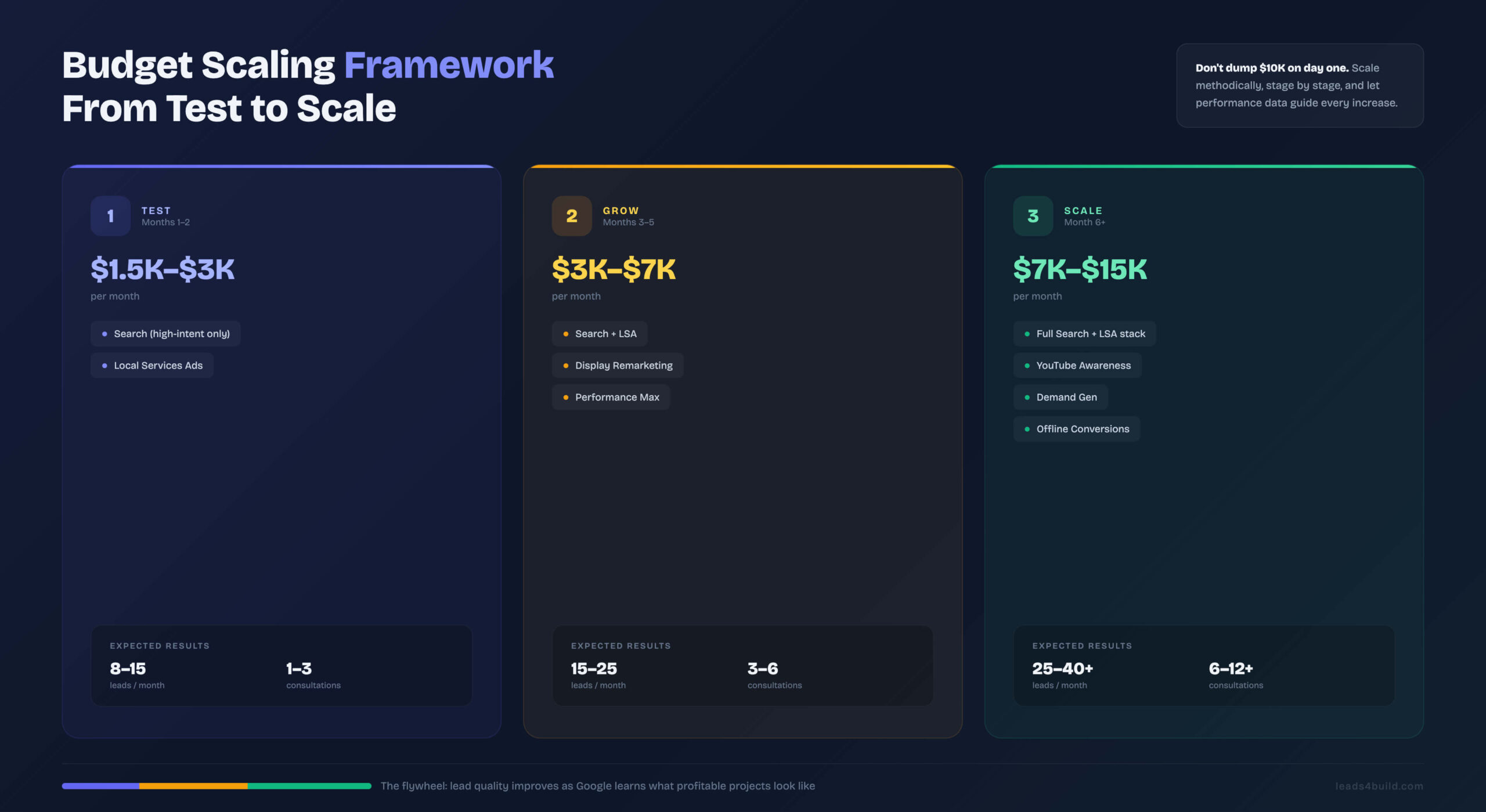
Stage 1: Test ($1,500–$3,000/mo) — Months 1–2
Campaigns: Search (high-intent keywords only) + LSA Goal: Establish baseline CPL, identify which keywords and ads generate real leads What you’re learning: Which search terms drive consultations, what your landing page conversion rate looks like, and what your initial cost per lead is
Expected results: 8 to 15 leads per month, 1 to 3 booked consultations. Your CPL will be at its highest during this phase because Google is still learning. That’s normal. Don’t panic and kill campaigns that haven’t had time to optimize.
Stage 2: Grow ($3,000–$7,000/mo) — Months 3–5
Campaigns: Search + LSA + Display Remarketing + Performance Max Goal: Lower blended CPL through remarketing, increase lead volume, expand keyword coverage
Add remarketing to bring back the 95% who visited and left. Add Performance Max to let Google find potential clients across YouTube, Discover, Gmail, and Maps using data from your existing conversions. Expand search keywords to adjacent services (bathroom remodeling, whole home renovation, basement finishing).
Expected results: 15 to 25 leads per month, 3 to 6 booked consultations. Your cost per lead should start dropping as remarketing fills in the gaps and Performance Max identifies new pockets of demand.
Stage 3: Scale ($7,000–$15,000/mo) — Month 6+
Campaigns: Full stack + YouTube Awareness + Demand Gen + Offline Conversions Goal: Google optimizes for revenue, not just leads. Brand recognition drives down blended CPL.
This is where the flywheel kicks in. YouTube awareness puts you in front of homeowners before they search. Demand Gen reaches them across YouTube Shorts, Discover, and Gmail. Offline conversions teach Google to prioritize high-value projects. Target ROAS bidding ties it all together.
Expected results: 25 to 40+ leads per month, 6 to 12+ booked consultations. More importantly, the quality of leads improves because Google has learned what a profitable project looks like for your business. Your cost per booked project should decline even as total spend increases.
The ROI Math: Why a $400 Lead Can Be Your Best Investment
Remodeling contractors obsess over cost per lead. “My CPL is $400. That’s too high.”
Is it? Let’s do the actual math.
You spend $8,000/mo on Google Ads. You generate 20 leads at $400 each. Your team books consultations with 8 of them (40% qualification rate). You close 3 projects (37.5% close rate). Average project value: $75,000. Total revenue from Google Ads that month: $225,000.
Your cost per booked project: $2,667. Your return on ad spend: 28:1.
That $400 CPL just generated $225K in revenue. Meanwhile, the remodeler using Angi with a $75 CPL is getting 50 leads a month, but half never answer the phone, a third want a $500 repair, and he closes one $12K bathroom refresh. His real cost per project is higher than yours.
Here’s how Google Ads compares to other remodeling lead sources:
| Channel | Avg. CPL | Lead Quality | Close Rate | Scalable? | Timeline |
|---|---|---|---|---|---|
| Google Ads (Search) | $150–$400 | High intent | 15–25% | Yes | Immediate |
| Google LSAs | $20–$85 | Medium-high | 10–20% | Limited | Immediate |
| SEO (organic) | $20–$50 (long-term) | High | 15–25% | Yes | 6–12 months |
| Angi / HomeAdvisor | $50–$150 | Low-medium | 5–10% | No | Immediate |
| Referrals / Word of mouth | $0 | Very high | 40–60% | No | Unpredictable |
| YouTube Awareness | $0.02–$0.10/view | Brand lift | Indirect | Yes | 3–6 months |
Cost per lead is a vanity metric for remodelers. Cost per booked project is the number that matters. And cost per booked project drops over time as offline conversions, remarketing, and brand awareness compound.

Frequently Asked Questions
How much should a remodeling company spend on Google Ads?
Start at $1,500 to $3,000 per month for a focused test. Scale to $7,000 to $15,000 as you identify what works. A common formula: allocate 5 to 10 percent of your target revenue to marketing, with Google Ads taking 30 to 50 percent of that budget. A remodeling company targeting $2M in annual revenue should budget $8,000 to $16,000/mo for marketing total, with $3,000 to $8,000 going to Google Ads.
Are Google Ads worth it for remodeling contractors?
Yes, if you track cost per booked project, not just cost per lead. A $400 lead that becomes a $75K kitchen remodel is a 187:1 return on that lead cost. Google Ads gives you immediate visibility for homeowners actively searching for remodeling services in your area. No other channel lets you target high-intent homeowners with this level of precision targeting on day one.
What is a good cost per lead for remodeling?
$150 to $400 is normal for remodeling. But that’s the wrong question. The right question: what’s your cost per booked project? If your CPL is $300 and you close 1 in 5 qualified leads on a $60K average project, your cost per project is $1,500 and your ROI is 40:1. A “cheap” $50 lead from a lead aggregator that never answers the phone costs you more in wasted time than a $400 Google Ads lead who books a consultation.
Should I use Google Ads or SEO for my remodeling company?
Both, on different timelines. Google Ads generates leads this week. SEO generates leads in 6 to 12 months. Start with Google Ads and LSAs for immediate pipeline, while building remodeling SEO services in the background. After a year, your blended cost per lead drops because organic leads supplement paid ones. The ideal setup: paid ads for now, SEO for the long haul.
How long until Google Ads generates remodeling leads?
First leads within days. Optimized campaigns in 4 to 8 weeks. You’ll see clicks and potentially leads within the first week. But the algorithm needs 2 to 4 weeks of data to start optimizing effectively. By month 2 to 3, you’ll have enough performance data to know which keywords, ads, and landing pages drive real consultations. By month 6 with offline conversions feeding data back, you’ll have a machine that gets smarter every month.
What to Do This Week
Three things you can do today, before you spend another dollar on ads:
First, pull your search terms report (if you’re already running Google Ads). Look for irrelevant queries eating your budget. Add them as negative keywords. This alone saves most remodeling companies 20 to 30 percent of their monthly ad spend.
Second, build one dedicated landing page for your highest-revenue service. Don’t send paid traffic to your homepage. A page with project photos, price ranges, testimonials, and a single CTA will double or triple your conversion rate overnight.
Third, start tagging your leads by project value in your CRM. Even a spreadsheet works. When you know which Google Ads clicks turned into $50K+ projects, you have the foundation for offline conversion tracking, the most powerful optimization tool in this entire guide.
Want a team that runs Google Ads like this for remodeling companies? Get a free Google Ads audit and we’ll show you exactly where your budget is going and where it should be going. For broader remodeling marketing strategy, our remodeling marketing guide covers SEO, social, and everything beyond paid ads.