

Landscaping Marketing: What Works in 2026 (By Budget)
You’re running a landscaping business. Maybe you’ve tried boosted Facebook posts. Maybe you’re spending $2,000 a month on Google Ads. Maybe your “marketing strategy” is a truck wrap and hoping word of mouth keeps the phone ringing.
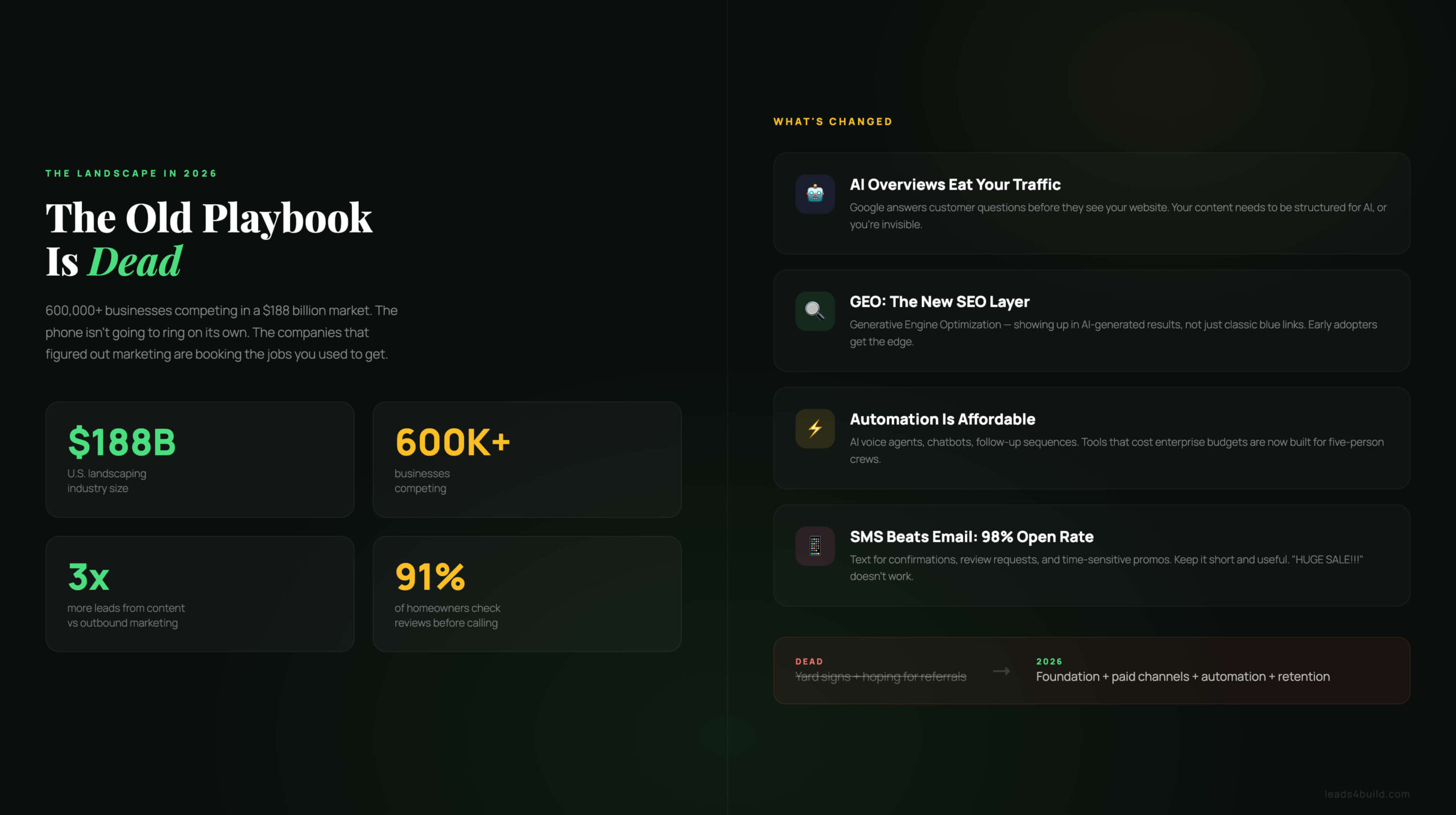
Here’s the problem: the landscaping industry has over 600,000 businesses competing in a $188 billion market. The phone isn’t going to ring on its own anymore. And the companies that figured out how to market in 2026 are booking the jobs you used to get.
This guide covers every landscaping marketing channel that works right now, organized by what to spend first based on your budget. Whether you’re a solo crew spending $500 a month or a multi-crew operation with $10,000 to invest, you’ll know exactly where your next dollar should go.
TL;DR: Landscaping marketing in 2026 starts with your foundation: a mobile-friendly website, an optimized Google Business Profile, and a review generation system. Your first paid dollars should go to Google Local Service Ads ($15–$40 per lead) and Google Ads PPC ($25–$60 per lead). Use email and SMS to keep past customers coming back, because repeat customers are your cheapest leads. Social media isn’t about going viral; it’s your portfolio, the first place homeowners check before they call. Budget 7–10% of gross revenue on marketing. Pick three channels, get them right, then expand.
The Landscaping Marketing Landscape Has Changed
Search “how much does landscaping cost” right now. That AI-generated box at the top of Google? It’s answering your customer’s question before they ever see your website. That didn’t exist 18 months ago.
Google AI Overviews are changing how homeowners find landscapers. When someone searches for landscaping information, they often get an AI-generated answer before they see any organic results. Your content needs to be structured so Google’s AI pulls from it, or you become invisible even with good rankings.
Then there’s Generative Engine Optimization (GEO). It’s the new layer on top of traditional SEO, focused on making sure your business shows up in AI-generated results, not just the classic blue links. Most landscaping companies haven’t heard of it. The ones who adapt first get a real edge.
Automation is the other shift. AI voice agents that answer your calls after hours. Chatbots that qualify leads on your website at 11 PM. Follow-up sequences that turn “I need to think about it” into a signed contract three days later. Tools that used to cost enterprise budgets are now affordable for a five-person crew.
The old playbook of “get some yard signs and hope for referrals” is dead. Here’s what replaced it.
Build Your Foundation First (Or Every Ad Dollar Is Wasted)
We see this pattern constantly: a landscaping company spending $2,500 a month on Google Ads, driving traffic to a website that hasn’t been updated since 2018. No click-to-call button. No photos of actual work. No reviews visible anywhere. They’re paying for clicks that bounce in three seconds.
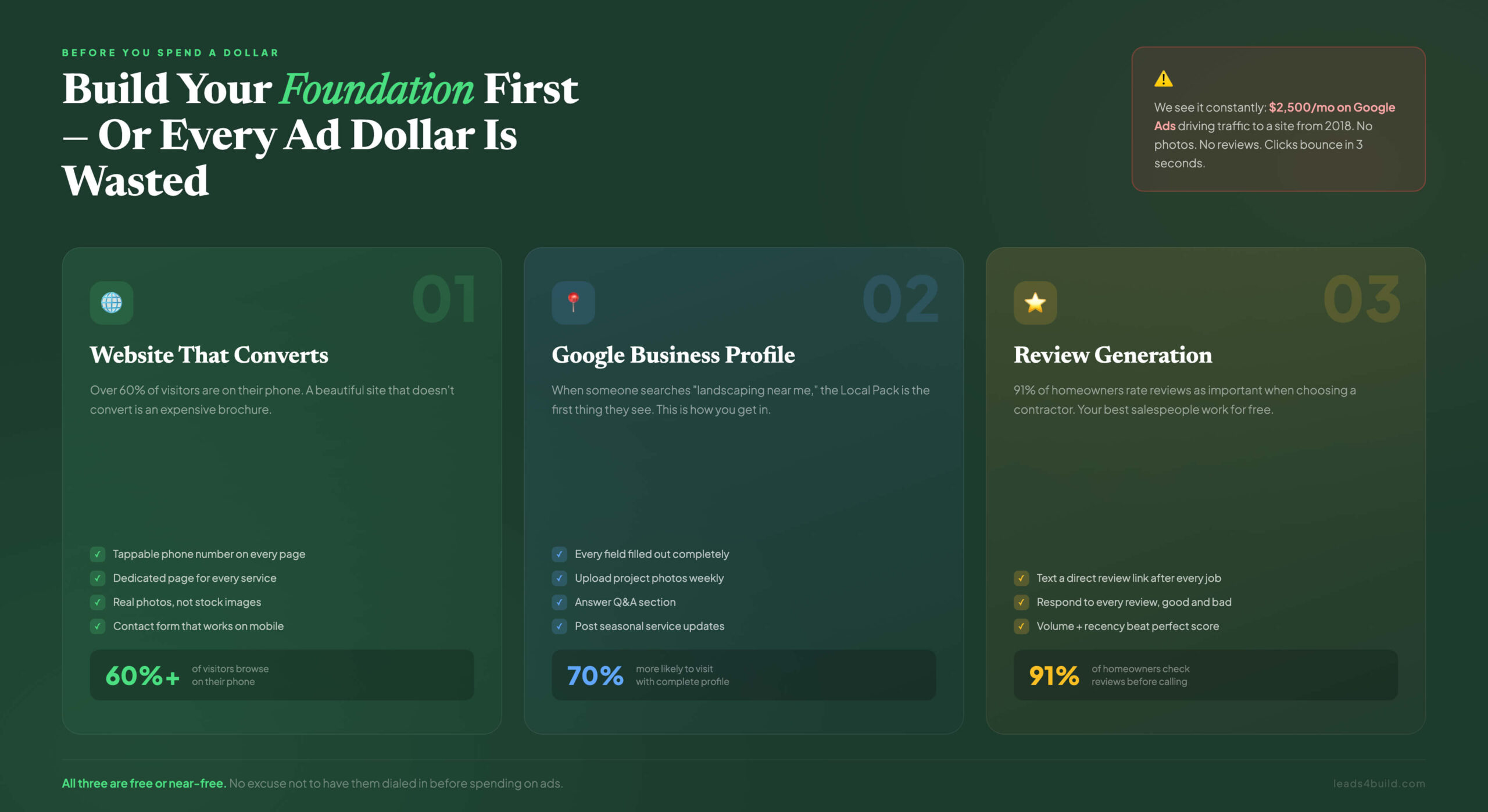
Before you spend a dollar on advertising, three things need to work.
Your Website Has to Convert, Not Just Exist
Over 60% of your visitors are on their phone. If your site isn’t mobile-first, you’re losing the majority of potential customers before they see what you offer.
Your website needs:
- A phone number that’s tappable from every page
- A contact form that actually works (test it from your own phone)
- A dedicated page for every service you offer (lawn care, tree removal, hardscaping, landscape design, irrigation — each gets its own page)
- Real photos of your crews and completed projects, not stock images of someone else’s garden
A beautiful website that doesn’t convert is an expensive brochure. An average-looking site with a clear phone number and real reviews will outperform it every time. Need inspiration? Check out these 25 landscaping website examples. If your site needs a rebuild, here’s what contractor website design looks like when it’s built to generate leads. And if your ads drive traffic to dedicated pages, our guide to landscaping landing pages covers what converts. We also offer landing page design if you want a team to build them.
Google Business Profile Is Your Most Valuable Free Tool
When someone searches “landscaping near me,” the first thing they see isn’t your website. It’s the Google Local Pack: three businesses with their ratings, hours, and phone numbers on the map.
Your Google Business Profile is how you get into that pack. According to Google, customers are 70% more likely to visit a business with a complete Google Business Profile. Fill out every field. Upload photos of your work weekly. Answer the Q&A section. Post updates about seasonal services. Choose your categories carefully because Google uses them to decide when you show up.
This is free. No excuse not to have it dialed in.
Reviews: Your Best Salespeople Work for Free
According to a 2024 study by Clear Seas Research and ACHR News, 91% of homeowners rate online reviews as an important factor when choosing a contractor. That number shouldn’t surprise you. You check reviews before you hire someone. Your customers do the same before they call a landscaper.
The system is simple: after every completed job, text the customer a direct link to leave a Google review. Make it one tap. Don’t ask them to “find you on Google and leave a review” because they won’t. Respond to every review, good and bad. A thoughtful response to a negative review builds more trust than a wall of five-star ratings with no replies.
Volume and recency matter more than a perfect score. A business with 4.7 stars and 150 reviews beats a 5.0 with 8 reviews every time.
SEO and Content Marketing: The Long Game That Compounds
Paid ads stop working the second you stop paying. SEO is the opposite. The content you publish today keeps bringing in leads for years.
Local SEO: Show Up in the Map Pack
Local SEO for landscaping companies comes down to three things: your Google Business Profile (covered above), your local citations, and your website’s location relevance.
Local citations mean your business name, address, and phone number (NAP) are consistent everywhere online. Yelp, Angi, BBB, your local chamber of commerce, industry directories. If your address says “Suite 100” on your website and “Ste 100” on Angi, that inconsistency hurts your local ranking.
If you serve multiple cities, create a dedicated page for each one. Not thin pages with just the city name swapped out, but real pages with unique content about serving that area. “Landscaping Services in Scottsdale” should mention common yard challenges in that area and link to relevant projects you’ve completed nearby. Our local SEO services handle this for contractors who don’t have the bandwidth.
We have a complete guide to landscaping SEO that goes deeper on this.
Content Marketing: Blogs That Bring In Leads
Most landscaping companies either don’t blog at all or publish generic posts nobody reads.
The blogs that generate leads answer the questions your customers type into Google. “How much does a patio cost in Austin?” “Best time to aerate my lawn in the Midwest?” “Should I choose pavers or stamped concrete?” These are real searches from homeowners who are close to hiring someone.
Seasonal content is powerful. Publish “5 Signs Your Lawn Needs Spring Cleanup” in February, before people start searching. By the time the first warm weekend hits, your article is ranking and driving calls.
One article a month, targeting a real keyword, answering a real question. After a year, 12 pages work for you around the clock. According to Demand Metric, content marketing generates three times as many leads as outbound marketing while costing 62% less. That’s a compounding asset no ad budget can replicate.
Paid Advertising: Leads This Week
SEO takes months. Paid landscaping advertising produces leads this week. If you need the phone ringing now, this is where your budget goes first.
Google Local Service Ads: Your First $500/Month
If you’re spending on only one type of advertising, make it Google Local Service Ads.
LSAs show up above everything else in search results: above Google Ads, above organic results, right at the top with a “Google Guaranteed” badge next to your name. That badge tells the homeowner that Google has verified your business and backs the work.
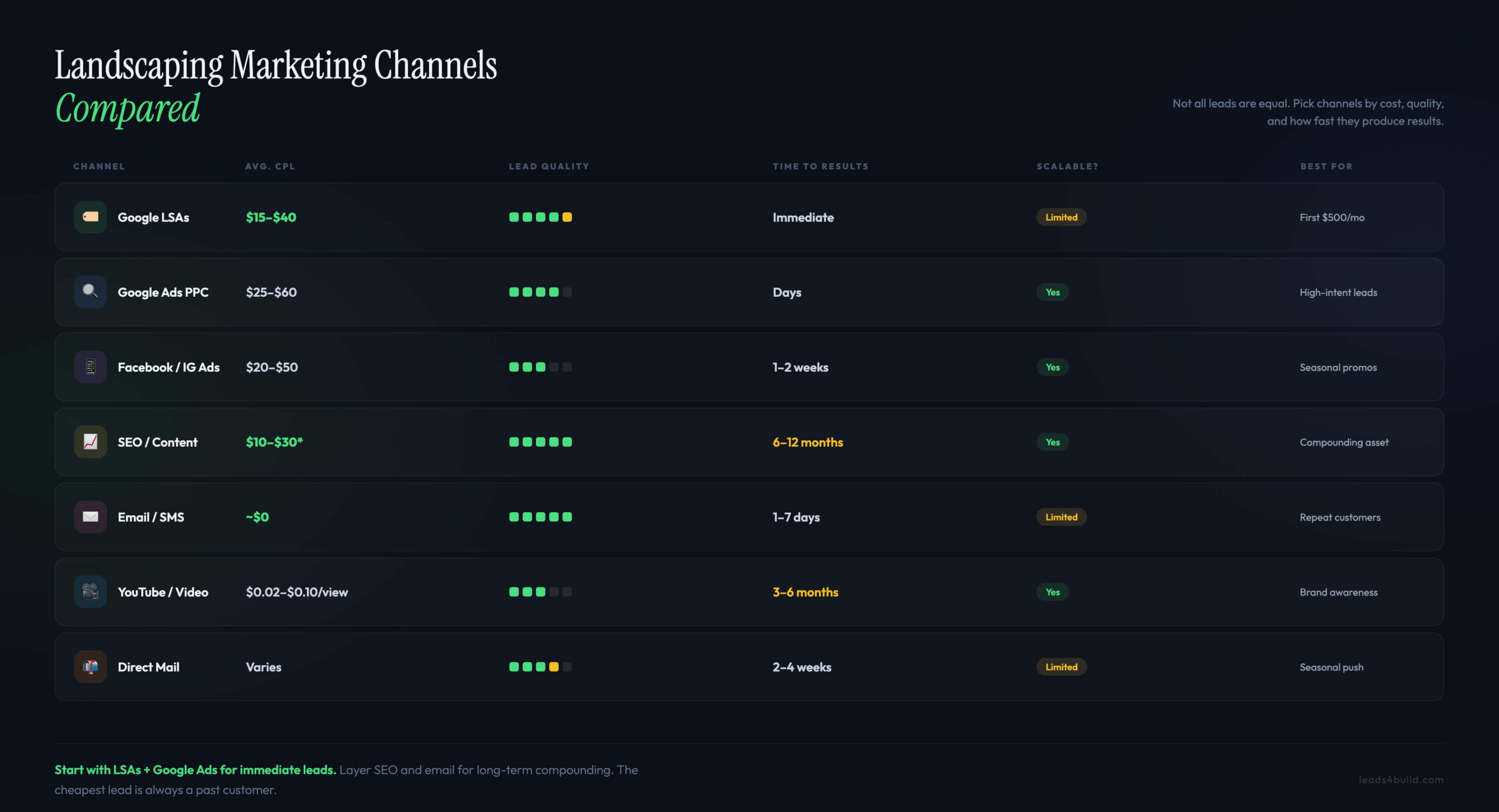
You pay per lead, not per click. For most landscaping companies, that’s $15 to $40 per lead, with 15 to 30 leads per month on a $500 budget. You need to pass Google’s screening (background check, license verification, insurance), but once you’re in, this is the highest-ROI advertising channel for landscapers right now.
Google Ads (PPC): Capture High-Intent Searches
Google Ads targets people actively searching for your services. When someone types “landscaping services near me” or “tree removal in Denver,” your ad shows up.
The average cost per lead for landscaping PPC campaigns runs $25 to $60, depending on your market. In competitive metros, it can run higher. In smaller markets, you might see leads under $20.
Here’s where most landscaping companies waste money: they set up a campaign with broad keywords, let it run on autopilot, and two months later have no idea which clicks turned into actual jobs. Proper conversion tracking, negative keyword lists, and weekly optimization are the difference between profitable ads and an expensive experiment. That’s why most of our clients use managed Google Ads campaigns instead of running it themselves.
Facebook and Instagram Ads: Visual Sells
Landscaping is one of the most visual industries out there. Before-and-after photos of a backyard transformation stop the scroll in ways most businesses can only dream about.
Facebook and Instagram ads are best for:
- Seasonal promos: “Spring cleanup special. $199 for first-time customers.”
- Maintenance plan signups: Build recurring revenue during slow months
- Brand awareness: Stay visible so when they need a landscaper, your name comes first
- Retargeting: Show ads to people who visited your website but didn’t call
Geo-target to your actual service area. Use your real work photos, not stock images. Homeowners hire local companies that look like local companies. We run paid social campaigns for contractors if you want help setting this up.
Video Marketing: Show Your Work in Motion
Landscaping is visual. Video makes it unforgettable.
YouTube: Drone Footage and Transformations
YouTube is the second-largest search engine. Homeowners go there for “backyard makeover ideas,” “how to choose a landscaper,” and “paver patio installation.” If you’re not there, someone else is building that trust.
You don’t need a production crew. A phone and a drone (even a $300 one) is enough. Film time-lapse transformations. Walk through completed projects explaining design choices. Show your crew in action. The authenticity of a real landscaper explaining their work beats a polished corporate video every time.
Video Ads: Target Homeowners in Your ZIP Code
YouTube lets you run ads only for people in your service area. A 15-second video of a backyard transformation with “Spring bookings open. [Your Company], serving [City]” costs pennies per view. Compare that to $30+ per click on Google Ads. We set up targeted video ad campaigns for contractors who want to test this channel.
Email, SMS, and Automation: Your Cheapest Leads
The cheapest lead is a past customer. They already trust you, they know your work, and they don’t need convincing. Email, SMS, and automation keep those relationships active.
Email: 4 Sequences That Run on Autopilot
Most landscaping companies collect customer emails and never use them.
Set up four sequences and you’re ahead of 90% of competitors:
- Seasonal reminders: “Spring is here. Time to schedule your lawn cleanup before we’re booked out.”
- Maintenance plan promos: “Lock in weekly mowing at last year’s rate. Here’s how.”
- Win-back campaigns: “Haven’t heard from you in over a year. Here’s $50 off your next service.”
- Post-service follow-up: “Thanks for choosing us. Here’s what we did and when your next service is due.”
The cost is almost zero compared to any paid channel.
SMS: 98% Open Rate
Text messages get a 98% open rate compared to roughly 20% for email.
Use SMS for appointment confirmations (reduces no-shows), review requests (text beats email 3-to-1 for response rates), and time-sensitive promos during slow weeks. Keep texts short and useful. “Your crew arrives tomorrow at 9am. Reply C to confirm” works. “HUGE SPRING SALE!!!” doesn’t.
Automation: AI Does the Follow-Up
We built an AI call agent for a contractor that automatically captured every inbound call and website form submission. The system asked qualifying questions about the job, property details, and timeline, then sent the complete info to the team via email and saved everything to the CRM. No human touch was needed until the crew showed up.
The result: zero missed leads, faster response times, and the owner stopped losing jobs to voicemail during busy season.
That’s what automation looks like in 2026. AI voice agents answering your phone around the clock. Follow-up sequences that re-engage leads who said “not yet.” CRM workflows that make sure nothing slips through the cracks. This is the kind of system we build for contractors. Check out our AI automation services for contractors, our CRM and marketing automation platform, or read the full case study to see how it works.
Social Media: Your Portfolio, Your Proof, Your First Impression
Social media isn’t a lead generation channel for landscapers. It’s a trust channel.
When a homeowner gets a recommendation from a neighbor, the first thing they do is pull up your Facebook or Instagram page. What they find in those five seconds determines whether they call you or scroll to the next name.
Which Platforms Matter
Facebook is non-negotiable. If your page hasn’t been updated in six months, every homeowner who checks it sees a red flag. Post weekly at minimum.
Instagram is where landscapers win. This is a visual platform, and your work is inherently visual. Before-and-after photos. Drone shots of finished patios. Time-lapse videos of a full yard transformation. This content practically creates itself.
Nextdoor is underrated. Homeowners actively ask for contractor recommendations there. Claim your page and stay visible.
LinkedIn makes sense only if you do commercial or property management work.
What to Post
Your daily work IS the content:
- Before-and-after project photos: The money shot. Show the overgrown mess and the finished result.
- Time-lapse and drone footage: A 30-second transformation video gets shared.
- Crew introductions: “Meet Carlos, 8 years on our team.” People hire people.
- Seasonal tips: “Three things to do before the first frost.” Short, helpful, shareable.
- Customer project spotlights: “Just wrapped a full backyard redesign for the Thompson family. New paver patio, pergola, and landscape lighting.” (With their permission.)
Post two to three times a week. Have your crews snap photos before and after every job. Ten minutes per post. Build the system and stick to it. Need content ideas? Try our free landscaping social media post generator.
Offline Marketing That Still Works
Every landscaping marketing guide online focuses on digital. But some of the best leads still come from the real world.
Truck Wraps, Yard Signs, and Door Hangers
Truck wraps cost around $2,500 and keep working for years. Every job site becomes a moving billboard. If you have three trucks, that’s thousands of daily impressions across your service area.
Yard signs are criminally underused. Place one at every active job site and leave it for a week after you’re done. One satisfied customer’s yard sign becomes five impressions on that street. Ask clients if you can keep it up on showcase properties and offer a small credit in return.
Door hangers in the neighborhood while you’re working a job: “We’re landscaping next door. Here’s 10% off your first service.” That’s hyper-targeted marketing for pennies per household.
Direct Mail and Community Marketing
Postcards before spring season, targeted by neighborhood and home value, still produce results. According to the ANA Response Rate Report, postcards achieve a 5.7% response rate, and direct mail earns the highest ROI of any paid marketing channel at 112%.
Sponsor a local youth sports team. Show up to community events. Partner with real estate agents who need landscaping done for staging. Build relationships with home builders who need crews for new construction. These aren’t measurable the way Google Ads are, but they build trust that no digital campaign replicates.
Marketing by Subniche: One Size Doesn’t Fit All
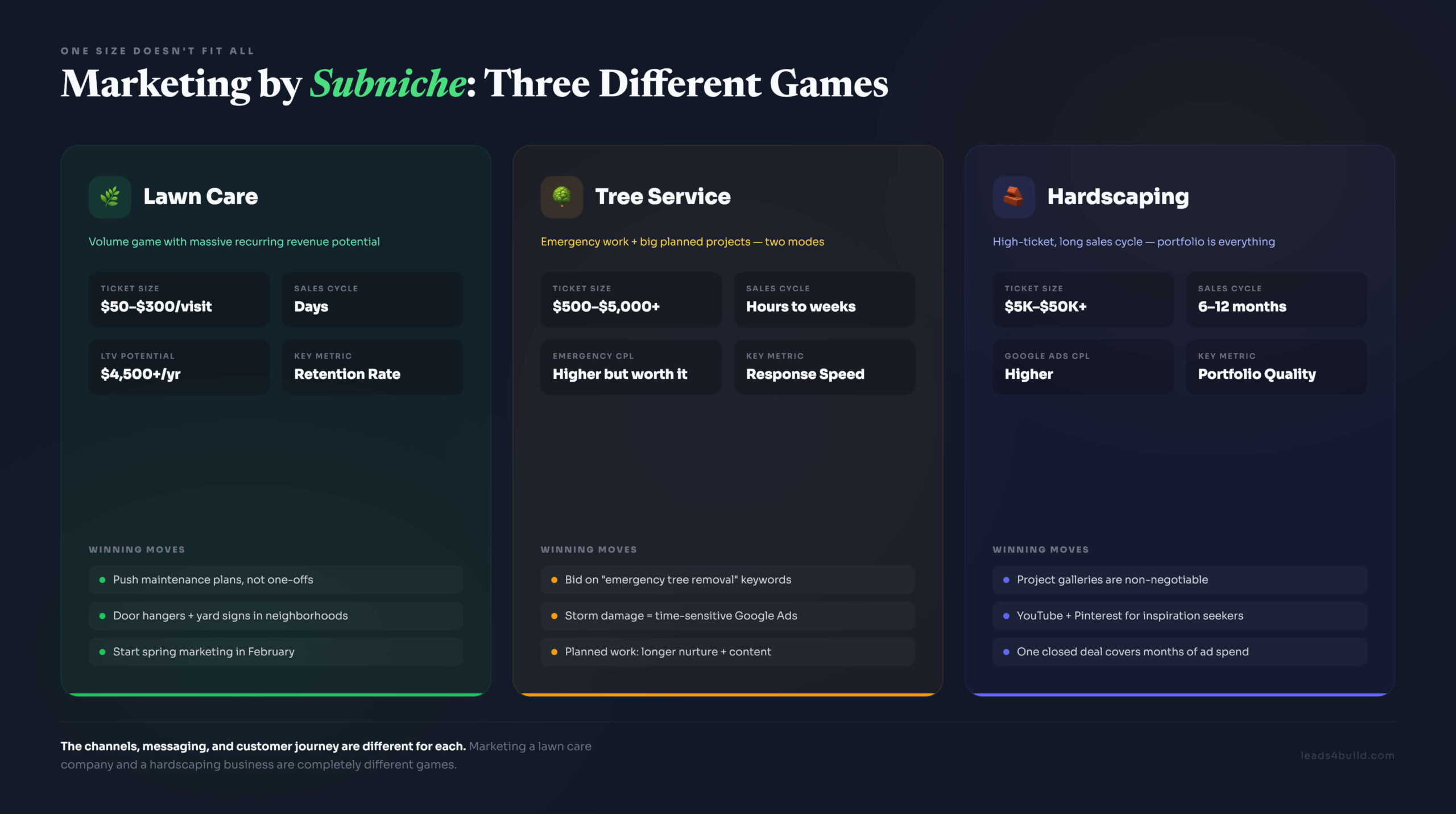
Here’s something no other landscaping marketing guide covers: marketing a lawn care company, a tree service, and a hardscaping business are three different games. The channels, the messaging, and the customer journey are all different.
Lawn Care: Volume Game, Recurring Revenue
Lawn care is high-volume, lower-ticket work with massive recurring potential. Your marketing should focus on maintenance plans and weekly service signups, not one-time projects. Door hangers and yard signs work exceptionally well because you’re targeting dense residential neighborhoods. Timing is everything: your spring marketing push needs to start in February, not April.
Tree Service: Emergency Work + Big Projects
Tree service marketing splits into two modes. Emergency storm damage work means bidding on “emergency tree removal” keywords in Google Ads, where CPL is higher but so is the job value. Planned work (removals, trimming, stump grinding) follows a longer decision cycle. We have a tree service advertising case study that shows what a real campaign looks like.
Hardscaping: High-Ticket, Long Sales Cycle
Hardscaping projects (patios, pergolas, outdoor kitchens, retaining walls) run $5,000 to $50,000+. Homeowners research for six months to a year before committing. Your portfolio pages and project galleries are critical because they’re browsing inspiration sites like Houzz and Pinterest before they ever search for a contractor. Google Ads CPL is higher, but one closed deal covers months of ad spend.
How Much Should You Spend on Landscaping Marketing?
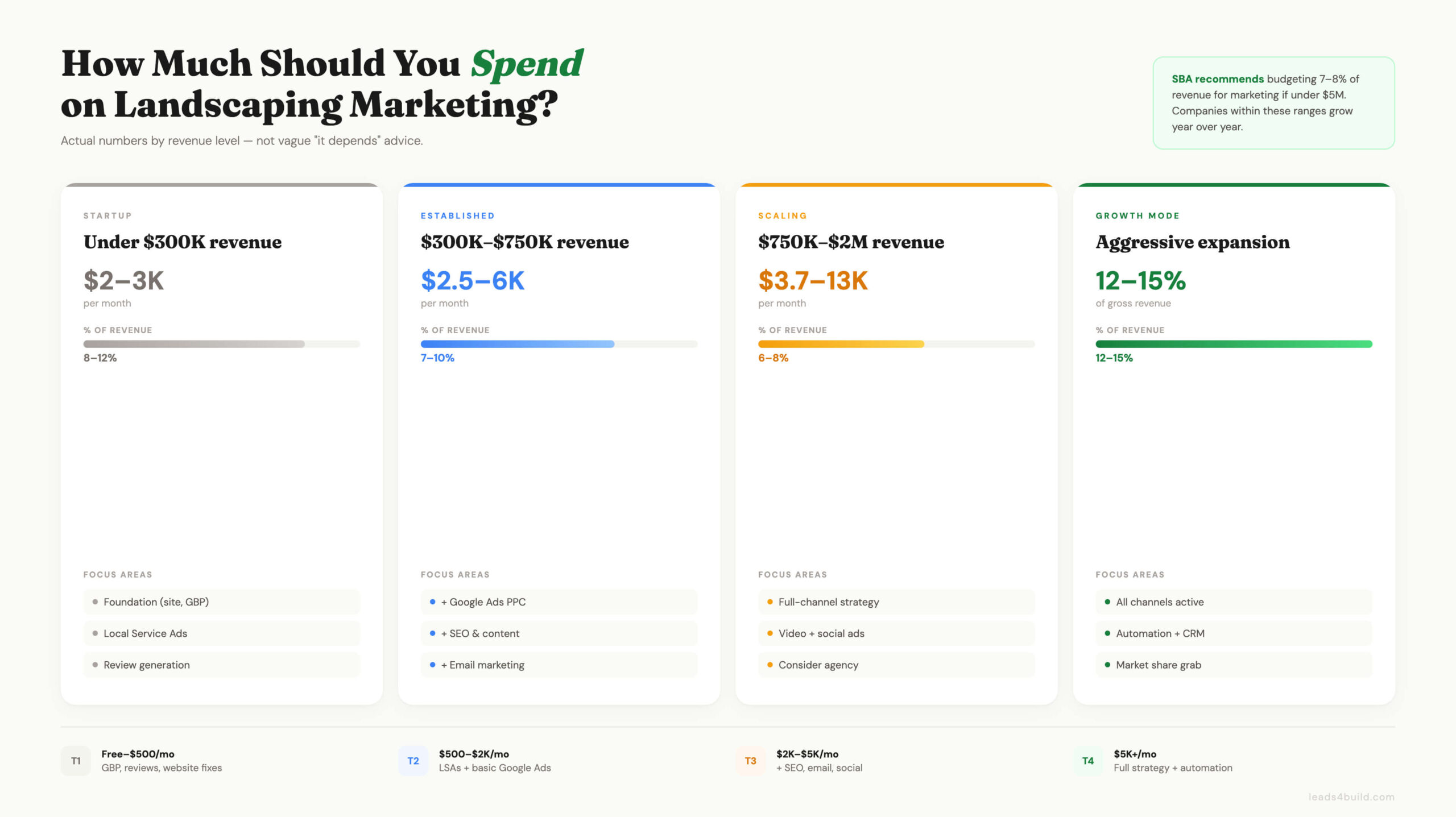
Every landscaping business owner asks this question, and most guides answer with a vague “it depends.” Here are actual numbers.
Budget by Revenue Level
| Annual Revenue | Marketing Budget (% of Revenue) | Monthly Budget Range | Focus Areas |
|---|---|---|---|
| Under $300K | 8–12% | $2,000–$3,000/mo | Foundation, LSAs, reviews |
| $300K–$750K | 7–10% | $2,500–$6,250/mo | Add Google Ads, SEO, email |
| $750K–$2M | 6–8% | $3,750–$13,000/mo | Full-channel strategy, consider an agency |
| Growth mode | 12–15% | Varies | Aggressive spend to capture market share |
The U.S. Small Business Administration suggests budgeting 7–8% of revenue for marketing if you’re under $5M in revenue. Landscaping companies we work with who fall within these ranges grow year over year. The ones spending less than 5% tend to flatline or lose ground.
Where to Spend First
Tier 1 (Free–$500/month): Google Business Profile, review generation, basic website fixes. Foundation work that costs almost nothing.
Tier 2 ($500–$2,000/month): Add Google Local Service Ads and a basic Google Ads campaign targeting your top 3–5 services. Leads start flowing.
Tier 3 ($2,000–$5,000/month): Layer in SEO, email marketing, and social media. You’re building long-term assets while running paid campaigns for immediate leads.
Tier 4 ($5,000+/month): Full strategy. Video content, Facebook ads, automation, content marketing, and potentially agency support. Every channel works together.
Seasonal Landscaping Marketing Calendar
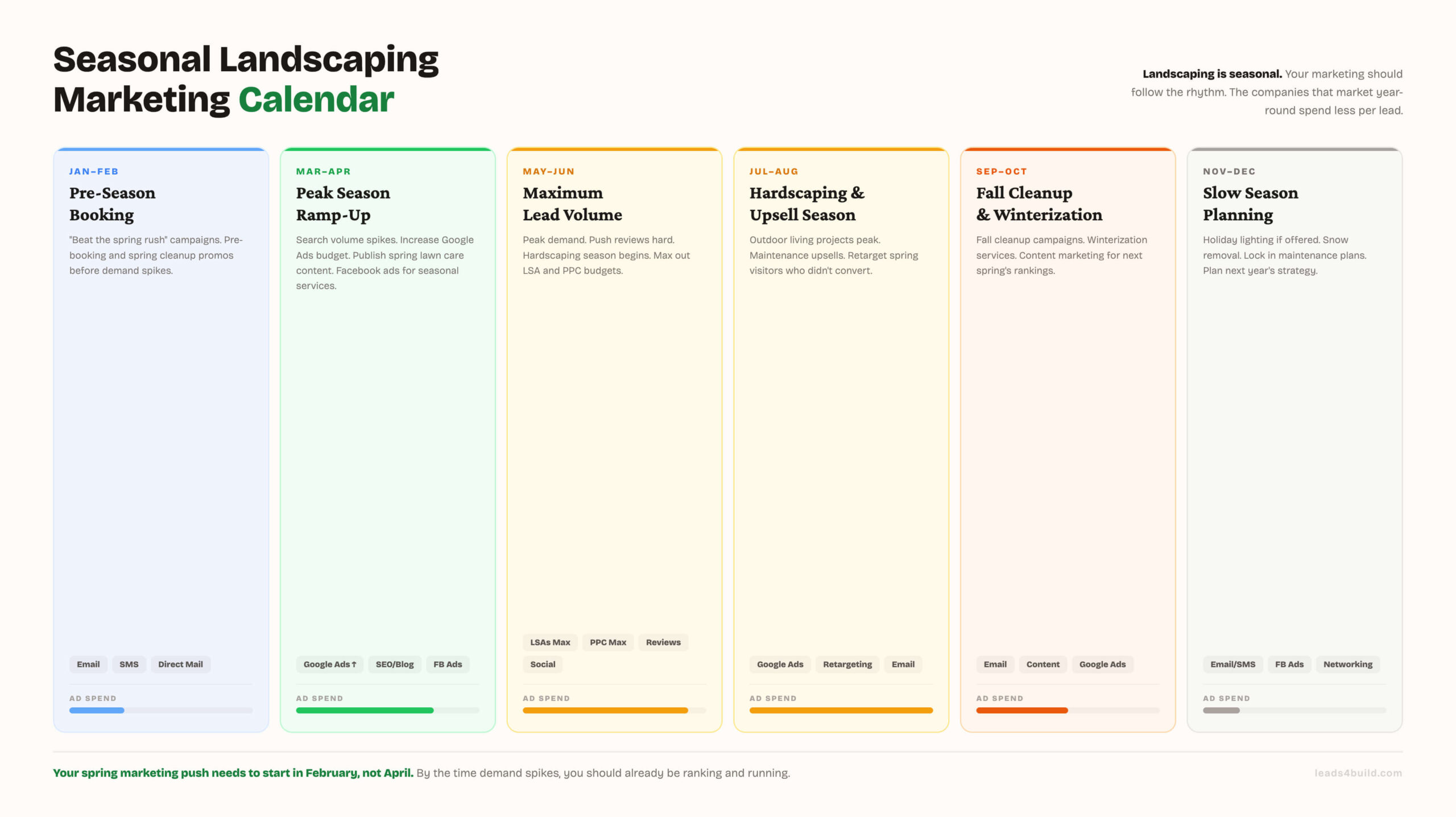
Landscaping is seasonal, and your marketing should follow the rhythm:
| Months | Marketing Focus | Channels to Push |
|---|---|---|
| Jan–Feb | “Beat the spring rush” pre-booking. Spring cleanup promos. | Email, SMS, direct mail postcards |
| Mar–Apr | Peak season ramp-up. Search volume spikes. Content about spring lawn care. | Google Ads (increase budget), SEO/blog, Facebook ads |
| May–Jun | Maximum lead volume. Push reviews hard. Hardscaping project season begins. | LSAs, PPC (max spend), review requests, social media |
| Jul–Aug | Hardscaping and outdoor living focus. Maintenance upsells. | Google Ads, retargeting, email promotions |
| Sep–Oct | Fall cleanup campaigns. Winterization services. | Email, content marketing, Google Ads |
| Nov–Dec | Slow season. Holiday lighting if offered. Snow removal. Plan next year’s marketing. | Email, SMS, Facebook (maintenance plans), offline networking |
The landscapers who market year-round spend less per lead than the ones who only advertise when the phone stops ringing.
Measuring What Works: The KPIs That Matter
If you can’t measure it, you can’t improve it. Track these across every channel:
Cost per lead (CPL): How much you spend to get a call or form submission. Track it separately for every channel. Benchmarks: LSAs $15–$40, Google Ads PPC $25–$60, Facebook $20–$50.
Lead-to-job conversion rate: What percentage of leads become paying jobs? If yours is below 25%, the issue might be your sales process, not your marketing.
Customer acquisition cost (CAC): Total marketing spend divided by new customers acquired. Know this number cold.
Lifetime customer value (LTV): A one-time spring cleanup is worth $300. A weekly mowing client who stays three years is worth $4,500+. Market to keep customers, not just to get them.
Revenue per marketing dollar: For every dollar spent, how much comes back? Track monthly and you’ll know exactly what’s working.
DIY vs. Hiring a Landscaping Marketing Agency
Be honest about what you can manage and what needs a professional.
What You Can Do Yourself
Google Business Profile. Update photos, respond to reviews, post weekly. Fifteen minutes.
Review requests. Text customers a direct link after every job. It’s a process, not a skill.
Basic social media. Post before-and-after photos two to three times a week. Have your crew snap pictures.
Email newsletters. Seasonal reminders in Mailchimp or your CRM. Four emails a year beats zero.
When to Hire Help
Google Ads. A mismanaged campaign wastes thousands monthly. If you don’t know what a negative keyword list is, hire someone.
SEO. Requires technical skill, consistent content, and months of patience. Most landscapers don’t have the bandwidth.
Website design. Your site is the hub. If it doesn’t convert visitors to calls, fix it before spending on ads.
Automation. Voice agents, CRM workflows, follow-up sequences. Powerful but require expertise to build properly.
If you’re spending $3,000 or more monthly and can’t tell me your cost per lead, you’re probably wasting money. That’s where a specialized agency earns its fee.
Frequently Asked Questions
How do I market my landscaping business?
Start with the foundation, then layer on paid channels. Optimize your Google Business Profile, build a review generation system, and make sure your website converts. Then invest in Google Local Service Ads ($15–$40/lead) and Google Ads(read landscaping ppc guide). Add email and SMS to retain past customers. Post before-and-after photos on social media two to three times a week.
How much should a landscaping company spend on marketing?
7–10% of gross revenue for most landscaping companies. That’s $2,000 to $6,000 per month if you’re doing $300K–$750K in annual revenue. Companies in growth mode may push to 12–15%. The contractors who stay within this range consistently grow year over year.
How do I get more landscaping customers?
Fix your foundation first, then invest in one paid channel and one retention system. Your website, Google Business Profile, and reviews need to be solid. Then turn on LSAs or Google Ads for immediate leads. Use email and SMS to turn one-time customers into repeat business. Referral programs and community marketing build steady word of mouth.
What social media platform is best for landscapers?
Instagram and Facebook are the two platforms every landscaping company needs. Instagram is ideal because landscaping is visual: before-and-after photos, drone shots, and project walkthroughs perform well. Facebook is where homeowners check your credibility before calling. Nextdoor is underrated for hyper-local recommendations.
Is landscaping advertising worth the investment?
Yes, when you track your numbers. Google LSAs generate leads at $15 to $40 each. If your average job is $1,500 or more, the ROI is clear. The problem isn’t that advertising doesn’t work. It’s that untracked, unmanaged advertising wastes money without anyone noticing.
What to Do Next
Landscaping marketing has more channels and tools available than ever. That’s the opportunity and the problem. You can’t do everything at once.
Start with three things: fix your foundation (website, GBP, reviews), turn on one paid channel (LSAs or Google Ads), and set up one retention system (email or SMS). Get those working. Measure the results. Then expand.
The landscapers who grow consistently aren’t doing the most marketing. They’re doing the right marketing and actually tracking what works.
Want to know what’s working for landscaping companies like yours? Book a free strategy call or explore our landscaping digital marketing services. We’ll look at your current marketing, show you where the gaps are, and tell you exactly where your next dollar should go.